Tornado Damage Roof Repair
Documentation and repair planning for tornado damage roof repair on commercial roofs in the Las Vegas valley.
Physical Evidence of Rotational vs. Straight-Line Wind Damage
Straight-line microburst damage on a Las Vegas commercial roof shows directional consistency: perimeter membrane lift on the windward face, fastener pullout concentration on the windward corner zone, and a damage gradient that diminishes from the windward edge toward the leeward zones. The damage tracks a single prevailing direction relative to the storm track, and the ASOS wind data from Harry Reid International Airport or the North Las Vegas Airport station typically confirms that directional signature.
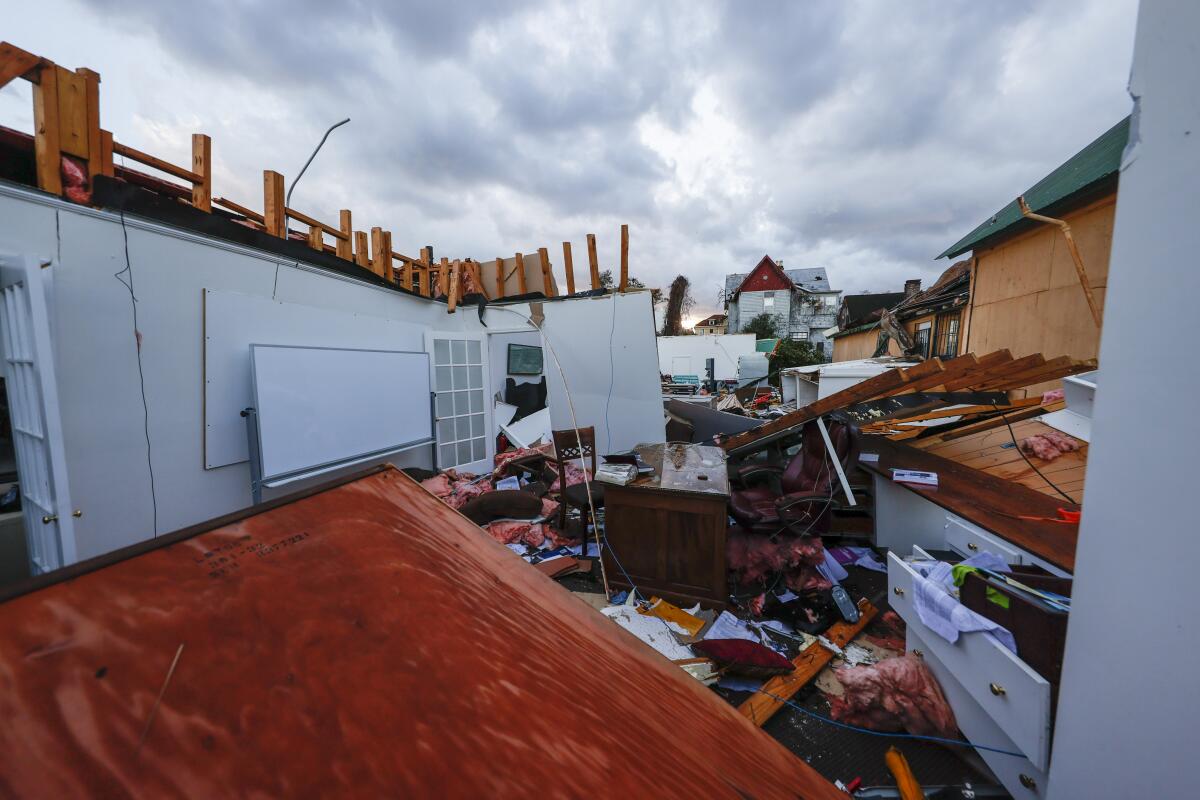
Rotational wind damage shows a different pattern: membrane displacement that originates from multiple directions on the same roof, fastener pullout that concentrates at different corners than would be predicted by a single-direction wind load, and in more severe events, catastrophic perimeter pull-off that wraps around the building perimeter rather than concentrating on a single windward face. On the building interior, rotational events can produce differential pressure loading that pushes parapet walls outward rather than in the prevailing wind direction.
We document both patterns at inspection, photograph the directional indicators — debris distribution, membrane displacement geometry, parapet lean direction — and note the pattern in the scope package. We do not make the final determination of whether an event meets NWS tornado classification; that is the NWS storm survey team's function. We document the physical evidence on the roof and include the NWS storm survey report reference when it is available.
Emergency Response Protocol for Southern Nevada Tornado Events
When an NWS Las Vegas tornado warning or confirmed post-event tornado survey affects a Clark County commercial building, our emergency response protocol activates immediately. The first crew on-site performs a safety assessment before any roof access — rotational wind events can produce structural wall damage and compromised deck connections that are not visible from ground level. We do not walk a roof that has sustained potential structural damage without a ground-level perimeter assessment first.
Temporary dry-in on a tornado-damaged commercial roof follows the same discipline as any other emergency: we cover only what we can confirm is structurally sound, we document every temporary repair point photographically before covering it, and we keep the temporary repair scope entirely separate from the damage documentation to avoid compromising the claim basis. Emergency tarping over large pull-off zones is photographed, GPS-logged, and noted in the scope package with the date and time of the temporary repair.
If the event produced structural wall or deck damage that requires engineering review before permanent repair, we flag those locations in the inspection documentation and recommend the building owner engage a structural engineer before the permanent roofing repair scope is finalized. We do not cover structurally compromised deck or reattach membrane to walls with unknown structural capacity — and we document that decision explicitly in the inspection report.
Coordinating Documentation with NWS Storm Survey Findings
When the NWS Las Vegas office dispatches a storm survey team after a suspected tornado event, the survey report typically identifies the touchdown and liftoff points, the EF rating, and the affected path. We cross-reference our roof-level damage documentation against the NWS survey findings: does our damage footprint fall within the documented tornado path? Does the physical evidence on the roof align with the EF intensity rating the survey team assigned? Those cross-references strengthen the claim attribution documentation.
For events where the NWS survey determined the event was an extreme straight-line wind event rather than a confirmed tornado, we update the documentation accordingly. The physical evidence we collected does not change — but the peril classification in the scope package is updated to match the official determination. Some Nevada commercial property policies have different deductible structures for tornado versus wind, and accurate peril classification prevents the claim from being processed under the wrong coverage provision.
Where an event produced damage in areas outside the NWS-confirmed tornado path — damage consistent with the outflow microburst that accompanies tornado-producing storms rather than the tornado itself — we document those locations as wind damage rather than tornado damage and separate them in the scope package.
Frequently asked questions
We are outside the confirmed tornado path — does our wind damage still qualify for the claim?
Wind damage from the outflow microburst that accompanies a tornado-producing storm typically qualifies as a wind peril claim even if your building is outside the confirmed tornado path. The physical evidence on your roof — fastener pullout, membrane edge lift, flashing displacement — documents the wind loading regardless of whether the generating event was tornado or straight-line. We document the damage as the wind peril it is.
How long does it take to get a tornado damage inspection?
We prioritize emergency response for confirmed rotational wind events. After the NWS issues a damage survey report, we can typically mobilize within 24 to 48 hours for commercial buildings in Clark County. Henderson and North Las Vegas commercial corridors are same-day for emergency dry-in response, followed by full documentation scope within 48 to 72 hours.
Do you work with Nevada carriers on tornado claims specifically?
We produce documentation that any Nevada commercial property adjuster can work from — zone diagrams, directional damage maps, GPS-tagged photo logs, NWS storm survey cross-references, and written repair-vs-replace scope. The claim handling is the carrier's and adjuster's function. Our function is giving them a complete and accurate picture of what happened to the roof.
Tornado or extreme wind damage to a Las Vegas commercial roof?
We walk the roof, document rotational vs. straight-line damage patterns, cross-reference NWS storm survey findings, and produce a scope package your adjuster can use to process the claim.