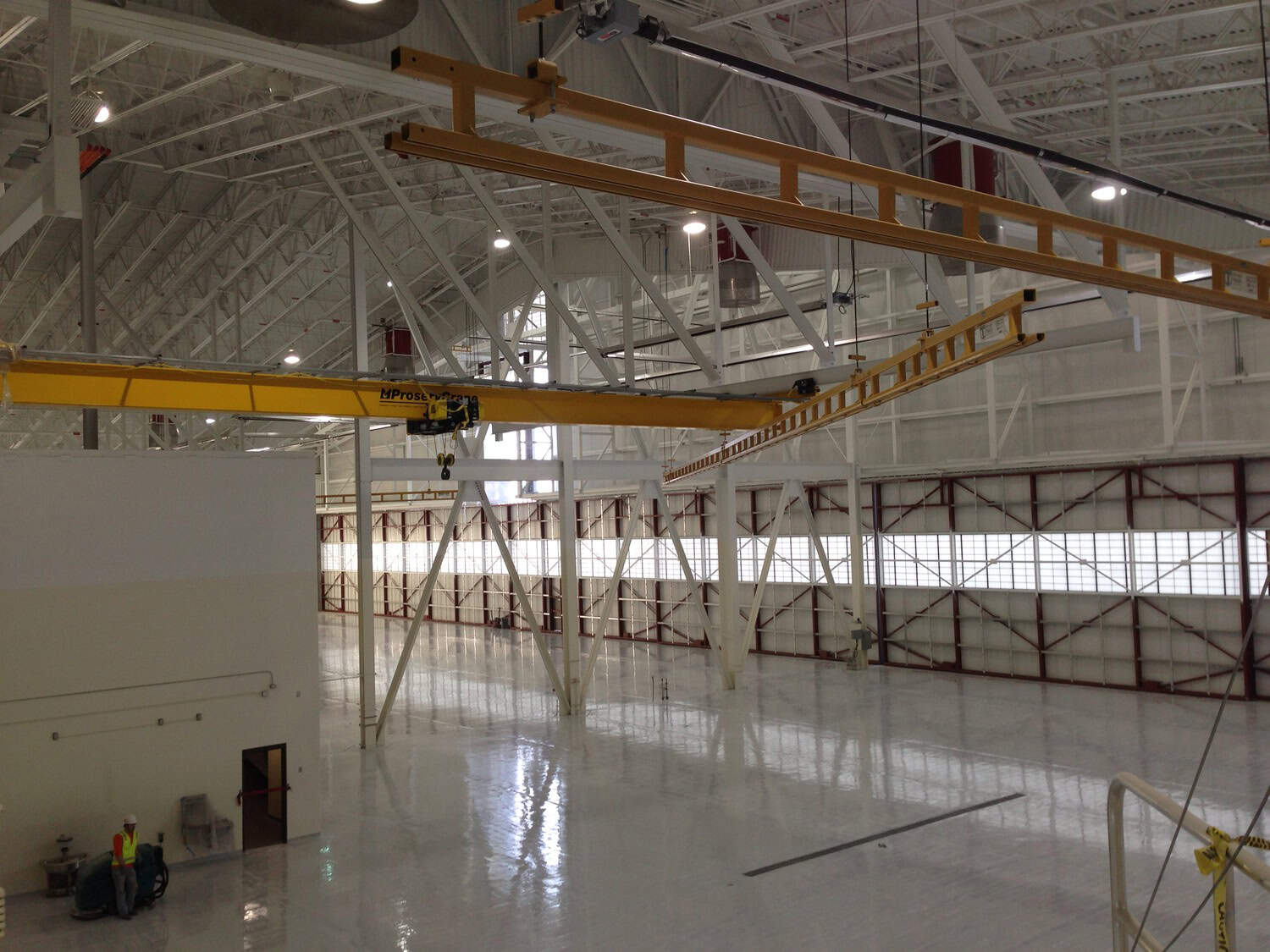
Aerospace Defense Roofing
Documented roof planning for aerospace defense roofing across Las Vegas commercial facilities.
Aerospace & Defense Roofing Questions
Can your crews work on federal installations or DoD facilities?
Yes. We work with facility security officers to complete the necessary base access credentialing for our crew members. Lead time for clearance varies by installation — we factor it into the project schedule upfront rather than discovering it during mobilization.
What documentation do you provide for defense or government facility work?
We provide full prevailing wage certified payroll (if applicable), material submittals for spec compliance, daily logs, third-party inspection coordination, LEED or sustainability documentation if required, and a final warranty package formatted for federal facility records systems.
How do you handle active operations during a roofing project on a facility that can't shut down?
We develop a phased work plan with the facility manager and base operations officer — sectioning the roof into work zones, maintaining dry-in protection on any open sections, and scheduling loud or disruptive work during approved windows. Our pre-construction checklist includes noise, vibration, dust, and chemical exposure considerations for every zone adjacent to active operations.
Do you work on classified facilities?
We work on the building envelope — roofs, walls, and flashings — which in most cases does not require classified access. For facilities where roof access itself requires a clearance, we identify that requirement early and work with the government contracting officer to plan accordingly.
What roof systems are best suited for defense manufacturing and laboratory environments?
TPO and PVC membrane systems are most common for new and re-roofing work due to their resistance to chemical splash and UV degradation. Standing seam metal is preferred on high-bay structures where long-term performance and minimal maintenance are prioritized. We always match the system to the specific exposure — a satellite integration cleanroom has different requirements than a motor pool.
Commercial roofing for aerospace and defense facilities in Las Vegas, NV — Nellis Air Force Base, Nevada Test & Training Range, and Area 51.
Healthcare roofing in Las Vegas operates under a different set of rules than standard commercial work, and those rules are not negotiable. An Infection Control Risk Assessment (ICRA) must be completed before any production begins on or adjacent to occupied patient areas. Hot-work permits — for heat welding, torch work, or any open-flame operation — require sign-off from the hospital's fire safety officer on each specific day and location. Rooftop helicopter pad access cannot be blocked by staging equipment or crane swing radius. Emergency vehicle routes around the building perimeter stay clear throughout the project.
Las Vegas's major hospital campuses have added building phases at intervals over the past four decades, which means a single campus often has multiple roof generations side by side — original modified bitumen from the 1980s adjacent to first-generation TPO from the early 2000s adjacent to newer construction still on warranty. At UMC's Charleston Boulevard campus, the level of building integration means that a project on one roof section may require coordination with mechanical systems serving an adjacent wing. We map each campus before we scope and produce a plan that accounts for every constraint before we present a price.
Hospital rooftops in Las Vegas also carry a density of mechanical equipment that most commercial buildings never approach — large Every one of those elements represents both a coordination requirement and a flashing detail that must be executed cleanly without interrupting the system it serves.
ICRA Compliance on Las Vegas Medical Campuses
The Joint Commission and Nevada State Health Division surveyors hold Las Vegas hospitals to the same infection-control construction standards applied nationally. An ICRA identifies the risk tier for the project area, defines the containment measures required before production begins, and establishes the monitoring protocol that remains in effect throughout the work. For a project above an occupied ICU floor at Sunrise Hospital or above a surgical suite at St. Rose Dominican Siena, the ICRA tier is high — requiring negative-pressure containment barriers at all roof access points, HEPA-filtered air handling for any dust-generating operation, daily containment inspection logs, and crew decontamination before re-entering the building.
We assign an infection-control lead to every hospital project. That person attends the pre-construction ICRA meeting with the facility's infection-control officer, executes the hospital's contractor acknowledgment documentation, and signs the daily pre-production checklist confirming containment measures are in place before crews touch any surface. If the hospital's IC officer calls a stop-work for a protocol deviation, we stop — and we do not restart until the deviation is documented, corrected, and re-inspected. That is not a customer-service posture; it is the regulatory baseline that Joint Commission-accredited hospitals in Nevada require.
Rooftop work at Cleveland Clinic Lou Ruvo Center for Brain Health — the Frank Gehry-designed campus on West Charleston Boulevard — presents additional coordination requirements because of the building's architectural complexity and proximity to the Symphony Park development. The facility's roofing is not standard flat-membrane; the building's sculptural form creates unconventional drainage pathways and flashing geometries that require a custom scoping process rather than application of standard commercial procedures.
Rooftop Equipment Coordination at Las Vegas Hospitals
UMC's campus on West Charleston has one of the most mechanically dense rooftop environments in the Clark County healthcare system. Large cooling towers, air handlers serving operating suites, and medical-gas system vents all occupy roof space that must be navigated and re-flashed on any replacement project. Cooling towers cannot be taken offline during a project without activating backup cooling — and most hospital facilities in Las Vegas run their cooling plants at or near capacity during the summer months when ambient temperatures exceed 110°F and the building's cooling load is at its seasonal peak.
Mountain View Hospital on Hualapai Way in the Summerlin corridor is a growing campus with multiple building phases constructed 2005-2020. The newer building phases carry rooftop mechanical systems that are still within their maintenance warranty cycles — coordination with the mechanical contractor is required before any flashing work adjacent to those units begins. Summerlin Hospital on West Charleston is a similar multi-phase campus where building age varies significantly across the roof footprint.
Helicopter pad access is a non-negotiable constraint at St. Rose Dominican Siena and at UMC, which operates the region's Level I Trauma center. Crane placement, material staging, and even debris containment parapets cannot encroach on the approach and departure paths to the helipad. We survey helipad approach vectors during the pre-construction walk and document the clear-zone requirements before any equipment is positioned.
Membrane Systems and Scheduling for Healthcare Facilities
TPO is the dominant specification on Las Vegas hospital construction from 2000 forward — it is thermally compliant with Nevada's cool-roof SRI requirements, chemically stable against the range of exhaust emissions from medical facilities, and available in 80-mil thickness for high-mechanical-traffic rooftops that hospital construction typically requires. Older hospital buildings at UMC and Sunrise Hospital with original BUR or modified bitumen systems from the 1980s and early 1990s are appropriate candidates for full replacement rather than recover — the substrate condition and deck status on 35-45-year-old hospital roofs must be confirmed with core pulls before any scope is finalized.
Off-hours production is standard on Las Vegas healthcare roofing. Operating room schedules, ICU rounds, and neonatal unit protocols define acceptable windows for noise-generating and vibration-producing work. We build those windows into the production schedule before contract signing and review any drift with the facilities team in real time. For major roof sections above actively occupied clinical floors, production is limited to overnight windows — typically midnight to 5 AM — which creates longer overall project timelines that we account for in our pricing.
Monsoon season adds a layer of risk management to healthcare projects that does not exist in most other markets. An open roof section above an occupied ICU during an unexpected monsoon event would be an unacceptable outcome. During July through September, we work smaller sections, maintain same-day dry-in discipline as an absolute requirement, and build monsoon-event response into the facility notification protocol so that the hospital's facilities director knows our procedure before the first storm of the season.
Frequently asked questions
Do you have experience with ICRA documentation for Las Vegas hospital projects?
Yes. We have completed ICRA coordination on healthcare campus projects in Clark County and understand the tier system, the contractor acknowledgment process, and what Joint Commission-accredited facilities require before and during construction. We assign an infection-control lead to every hospital project and maintain daily containment logs.
Can you work on an occupied hospital without interrupting patient care operations?
That is the operating baseline for every hospital project we run. We do not interrupt HVAC systems serving occupied patient areas, we do not cause vibration events near imaging equipment without pre-approval from the engineering team, and we do not leave roof sections open overnight on facilities with active clinical operations. Any scope element that requires a shutdown or operational interruption is identified in pre-construction and scheduled in an approved window.
How do you handle helicopter pad access requirements at UMC and St. Rose?
We survey helipad approach and departure vectors during the pre-construction walk and document the clear-zone requirements before any crane, lift, or staging equipment is positioned. No equipment enters the helipad approach path at any point in the project. If a production sequence requires temporary encroachment in adjacent airspace, we coordinate with the hospital's facilities director and the helipad operations team before that work begins.
What is your response time for emergency roof leaks at a Las Vegas hospital?
Emergency dry-in response at UMC, Sunrise, and the Medical District corridor is within two to three hours. St. Rose Dominican at Siena in Henderson and Mountain View and Summerlin hospitals in the northwest corridor are three to four hours. For hospitals on our maintenance program, we maintain a standing emergency contact protocol with the facilities team — after-hours calls go to our project manager on duty.
Healthcare roofing scope for a Las Vegas medical campus?
Our project managers are experienced with ICRA documentation, hot-work permit coordination, helipad access constraints, and off-hours scheduling requirements at Clark County hospital facilities.