
Data Center Roofing
Documented roof planning for data center roofing across Las Vegas commercial facilities.
Penetration Protocols for Data Center Roofs
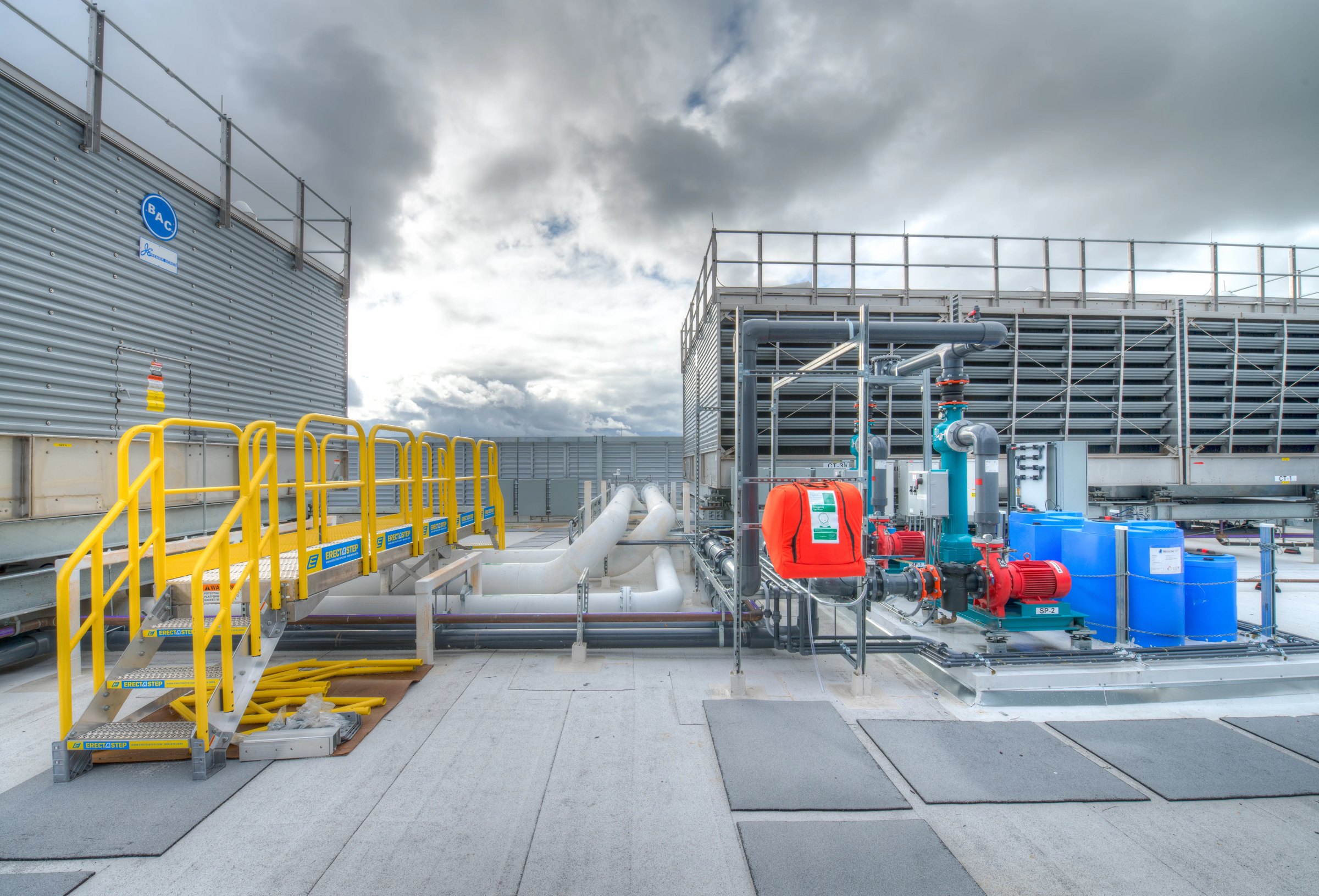
Data center roofs carry more penetrations per square foot than almost any other commercial building type. Conduit bundles feeding server room electrical infrastructure, fiber pathways for carrier connections, generator Each penetration is a potential water intrusion point. Each is also a potential operational impact if a contractor routes equipment across a conduit bundle or disrupts a cable path without identifying what it serves.
Our process on every data center project begins with a full penetration inventory — photograph, measure, and log every penetration against a roof zone diagram that the facility manager reviews and approves before production begins. During production, each penetration receives individual treatment: existing flashing stripped to the deck, deck inspected for corrosion or moisture damage, new curb or pitch-pan flashing installed to manufacturer specification, and a final photograph uploaded to the project log the same day. Fiber conduit penetrations receive a secondary water stop inside the conduit bore — a standard pitch pan seals the annular gap around the conduit but does not seal the bore itself.
Legacy data center buildings in the North Las Vegas and Henderson corridors that have had multiple tenant equipment installations over the years can accumulate penetration histories that are not fully documented. We perform a penetration audit before presenting a scope on any building where the penetration record is uncertain. That audit is priced separately and completed before the reroof contract is executed — the facility manager needs to know what they are buying before they commit.
Cooling-System Sequencing in Extreme Las Vegas Heat
Cooling towers on Las Vegas data centers run at or near capacity during June through September, when ambient temperatures sustain above 100°F and overnight lows in the upper 80s provide almost no natural cooling relief. Taking a cooling tower offline for flashing work during that period is not operationally feasible for most data center operators. We ask for access to the facility's maintenance schedule before finalizing the production sequence and build the cooling-adjacent work around the planned maintenance windows — typically scheduled months in advance — when a tower can be isolated without exceeding the facility's backup cooling capacity.
The diurnal temperature swing in Las Vegas — 40-55°F between overnight and afternoon peak during summer — creates thermal movement stress on every rooftop penetration and flashing daily. On a data center roof that cannot be shut down for annual inspections the way a standard commercial building can, that daily stress accumulates without routine inspection. Our maintenance contracts for Las Vegas data centers include penetration and flashing condition documentation at each annual visit, with photographic records that track degradation trends across inspection cycles.
During production, we impose a no-work buffer around active cooling units during peak heat hours. Equipment that is running at 90-95% capacity to maintain server room temperatures in July cannot absorb additional airflow restriction from a crew working directly around it. We schedule mechanical-adjacent work for morning hours before ambient temperatures climb, and we do not position staging or equipment in ways that block intake or exhaust paths on any active cooling unit.
Change Management and Uptime Documentation
Enterprise colocation operators and hyperscale facilities typically run a formal change management process for any work that could affect infrastructure. A roofing contractor on an active Switch Las Vegas or Aligned facility is a change event that gets logged, reviewed by the change advisory board, and approved before production begins. We have structured our pre-construction documentation to provide what a CAB needs: scope description, risk assessment by roof zone, rollback plan for any penetration work that encounters an unexpected condition, and the escalation contact chain for after-hours events.
At closeout, we deliver the standard commercial closeout package — warranty document, photo-keyed roof zone diagram, insulation and system specification on record, maintenance contract — plus a penetration manifest specific to data center requirements that maps every penetration on the roof to the system it serves. That document is added to the facility's infrastructure record and makes every future contractor who works the roof accountable to an accurate inventory rather than guessing at the contents of a pitch pan.
Frequently asked questions
Can you work on a live data center like Switch Las Vegas without interrupting cooling systems?
Yes, but it requires the facility manager's active cooperation on the production schedule. We build the sequence around the cooling system's maintenance windows, work cooling-adjacent penetrations during planned low-load periods, and never unilaterally disturb any mechanical penetration without written approval for that specific action on that specific date. We do not make field decisions that affect cooling infrastructure without facility-manager authorization.
How do you handle fiber and conduit penetrations through the roof?
We inventory every fiber conduit and conduit bundle penetration before production begins. Each one gets stripped to deck, a properly-sized pitch pan or curb flashing installed to manufacturer spec, and a secondary water stop applied inside the conduit bore. We photograph the completed detail and include it in the penetration manifest delivered at closeout. No tools or equipment are routed across conduit bundles at any point in the project.
How does Las Vegas's extreme summer heat affect data center roofing production?
Cooling systems at Las Vegas data centers run at or near maximum capacity during June through September. We impose no-work buffers around active cooling units during peak-heat hours, schedule mechanical-adjacent work for morning production windows, and do not position staging or equipment in ways that restrict intake or exhaust airflow on any running unit. We also limit tear-off section size in summer so that temporary insulation removal does not create additional heat load inside the building.
Do you carry the insurance and licensing required for data center roofing in Nevada?
Yes. We hold an active Nevada C-15a (Roofing) contractor license from the Nevada State Contractors Board, general liability, workers' compensation, and umbrella coverage at limits that support data center campus projects. Certificates of insurance naming the facility owner and operator as additional insured are provided before mobilization. We pull the applicable building permit — City of Las Vegas, Henderson, or Clark County — for all work above the permit threshold.
Data center roof scope for a Las Vegas facility?
We will walk the roof, inventory every penetration, and produce a scope that accounts for your cooling-system constraints and change-management requirements before we propose a production sequence.