
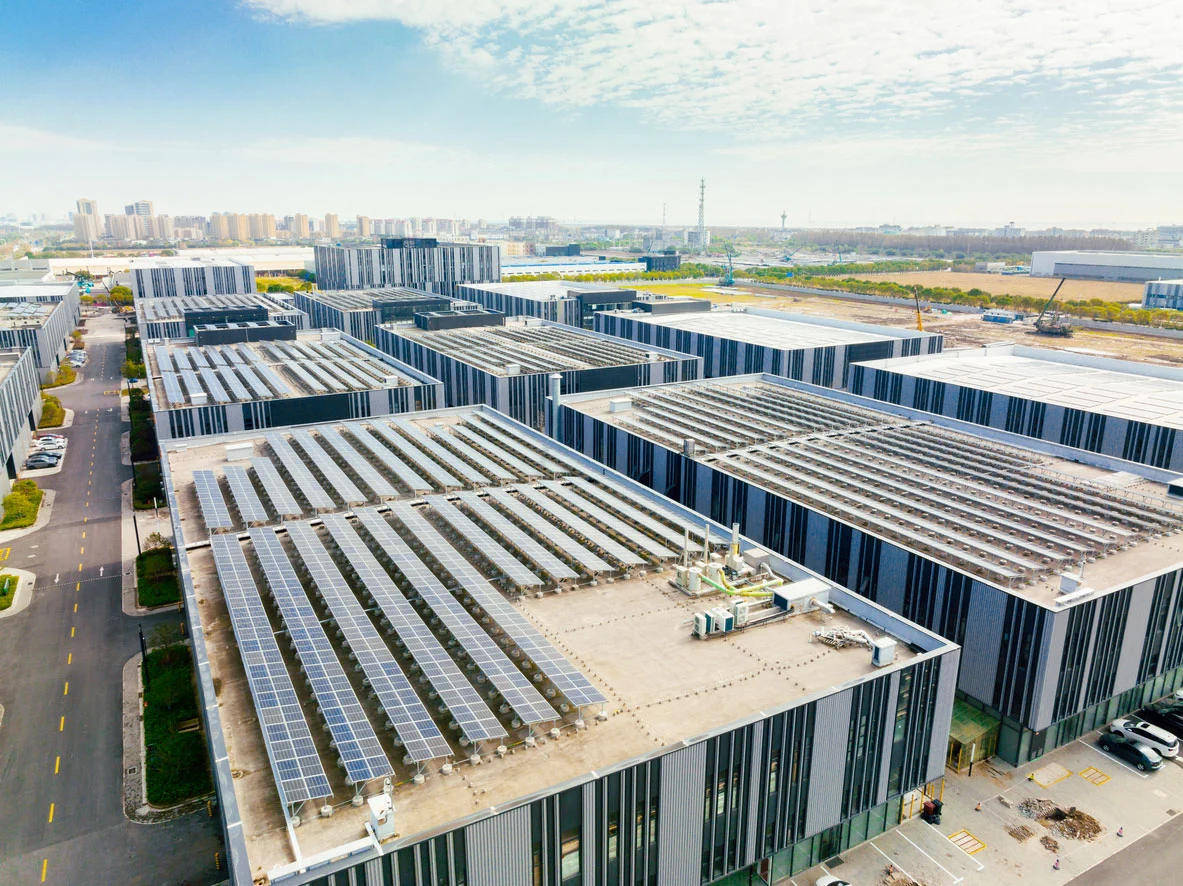
Manufacturing Industry Roofing
Documented roof planning for manufacturing industry roofing across Las Vegas commercial facilities.
Sequencing Around Active Production Lines
Before we write a scope for a Las Vegas manufacturing building, we walk the facility interior with the plant manager and map the production layout onto the roof area. Which areas of the roof overlie active machinery? Which overlie storage? Where are the sprinkler system risers and zone valves? A tear-off that generates debris above a precision machining cell or a food-grade packaging line is not an acceptable sequence. We design around those constraints in the project phasing plan, not during production.
Process exhaust fans and equipment vents on manufacturing rooftops require individual coordination before any nearby flashing work begins. At food-processing facilities in the North Las Vegas corridor, exhaust fan shutdown requires advance notice to the facility's safety and environmental team because the fans serve odor control and air-quality compliance functions. At metal fabrication facilities, fume exhaust from welding stations cannot be interrupted during active production shifts. We identify every functional exhaust penetration during the pre-construction walk and document the required shutdown coordination for each before the production schedule is finalized.
Manufacturing buildings in the Apex Industrial Park frequently have crane bays and overhead bridge cranes that operate during production hours. Rooftop crane rail penetrations and the expansion joint details that serve crane bay structures require specialized flashing approaches. We scope those details during the pre-construction walk rather than addressing them during production — they are not discoverable surprises on a properly planned project.
Industrial Exhaust and Chemical Exposure at Roof Level
Rooftop exhaust on manufacturing buildings in Las Vegas can carry chemical, thermal, or particulate loads that standard commercial membrane specifications do not anticipate. At facilities with solvent-based manufacturing processes, exhaust stack discharge zones can degrade standard TPO flashing faster than UV exposure alone. We assess the chemical exposure environment at each manufacturing facility and specify PVC flashing at penetrations where the exhaust chemistry is outside the tolerance range for standard TPO detail work.
Heat-generating processes — ovens, kilns, heat-treatment equipment, powder-coat curing chambers — create elevated rooftop surface temperatures in the immediate vicinity of their exhaust points. The membrane and flashing in those zones ages faster than the field of the roof. We identify these zones during the pre-construction walk, document the anticipated thermal exposure, and specify insulation and membrane assemblies in those areas that account for the additional heat load above ambient Las Vegas conditions.
The Levi Strauss Las Vegas distribution and processing facility represents the textile and garment processing tier of the North Las Vegas industrial market. Facilities in this category have steam exhaust, fabric-treatment chemical vents, and dust collection system exhausts that require individual penetration assessment. Our scope on any facility with diverse exhaust chemistry includes a penetration-by-penetration chemical exposure assessment before we specify flashing materials.
Desert Climate Performance for Industrial Roofs
The Apex Industrial Park sits on open terrain north of the Las Vegas Valley with limited wind shielding from surrounding development. ASCE 7-22 wind-uplift calculations for facilities in this zone require elevated corner and perimeter fastener densities compared to sheltered valley-floor sites. We document the wind-uplift design calculation for every manufacturing facility project and include it in the closeout file — a calculation that becomes part of the building record for the next capital cycle and for any insurance underwriting update.
Large-format manufacturing buildings are particularly susceptible to ponding because the long spans between structural supports often result in modest effective roof slopes. A roof that drains adequately under normal Las Vegas dry-season conditions may accumulate significant ponding during a monsoon event delivering 1.5 inches of rain in 45 minutes. We assess drain capacity and effective slope on every manufacturing building project and include tapered insulation or additional drain sizing in the scope where ponding risk is identified — not as an add-on, but as part of the base scope.
Energy code compliance at reroof matters for manufacturing facilities even when the building's primary heat load is from process equipment rather than passive solar gain. Nevada's ASHRAE 90.1-2019 baseline requires R-25 minimum effective insulation on low-slope commercial roofs. The incremental cost of bringing an older facility's insulation to code compliance at the time of tear-off is far less than addressing it separately. We document the insulation stack and confirm compliance in every project closeout file.
Frequently asked questions
Can you work on a Las Vegas manufacturing facility without shutting down production?
Yes. We map the production floor layout against the roof phasing plan before production begins, identify every overhead conflict, and sequence tear-off to keep active production areas protected throughout the project. Process exhaust fan shutdowns required for flashing work are coordinated in advance with the plant manager — we do not make unilateral decisions about any exhaust or ventilation system.
How do you handle chemical exhaust exposures on industrial rooftops?
We conduct a penetration-by-penetration chemical exposure assessment during the pre-construction walk. Where exhaust chemistry exceeds the tolerance range for standard TPO flashing — solvents, elevated-temperature exhaust, chemical-process vents — we specify PVC flashing material at those penetrations. The base field membrane may be TPO while specific high-exposure penetrations receive PVC detail work, which is documented in the project specification.
What are the wind-uplift requirements for Apex Industrial Park facilities?
Apex Industrial Park sites are on open terrain north of the Las Vegas Valley with limited shielding, which triggers ASCE 7-22 Exposure C conditions for most buildings. This requires higher corner and perimeter fastener densities than sheltered valley-floor sites. We calculate the wind-uplift design for each project, specify the fastener pattern accordingly, and include the calculation in the closeout file as part of the building's permanent record.
How does the Nevada energy code apply to manufacturing facility reroofs?
Nevada's ASHRAE 90.1-2019 baseline requires R-25 minimum effective insulation on low-slope commercial roofs regardless of occupancy type. Manufacturing facilities built before 2015 frequently have original insulation stacks below that threshold. We confirm effective R-value in every closeout file and include tapered polyiso additions to bring below-code assemblies into compliance as part of the base replacement scope.
Manufacturing facility roof scope in Las Vegas?
Our project managers will walk your facility, map the production floor against the roof phasing plan, assess process exhaust exposure at every penetration, and produce a written scope that keeps your operations running throughout the project.