
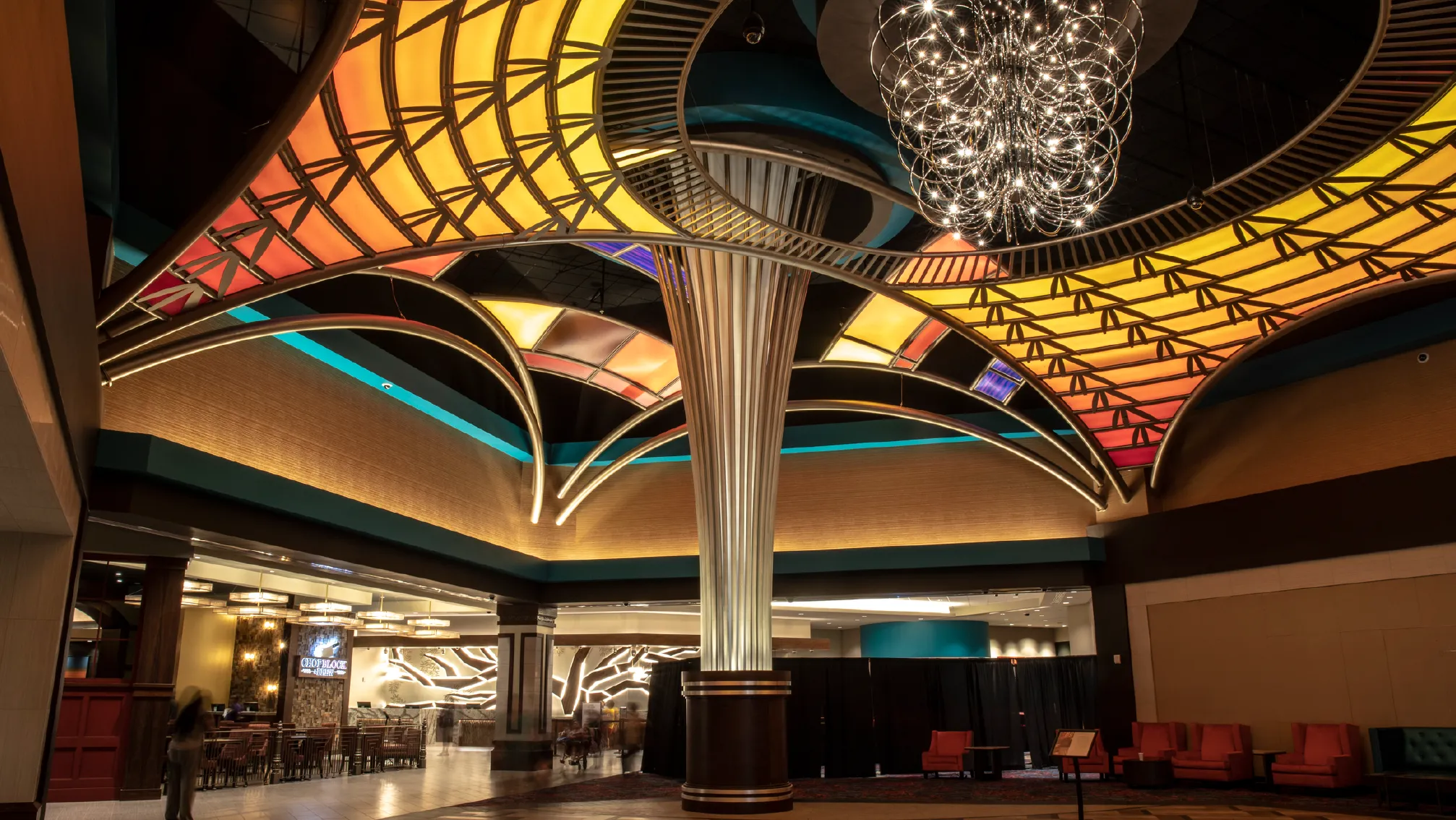
Casino Entertainment Roofing
Documented roof planning for casino entertainment roofing across Las Vegas commercial facilities.
Casino & Entertainment Roofing — Documentation Questions
What insurance limits and endorsements does casino roofing require?
Gaming property roofing typically requires $10M per occurrence general liability minimum, completed operations coverage for the full warranty term, additional insured endorsements naming the casino operator, the property owner, the tribal authority or gaming commission where applicable, and any entertainment programming partner with performance events in scope. Workers' compensation must be current and compliant with NV's gaming employment requirements. We provide the certificate in the format the risk manager's office requires — not a generic certificate with a generic additional insured endorsement.
What gaming authority notifications are required before roofing construction?
Requirements vary by gaming jurisdiction. Tribal gaming compacts in NV may require notification to the tribal gaming authority before construction above a certain contract value. State gaming control boards may require contractor background check submissions for companies performing work at licensed gaming facilities. We confirm the specific notification and contractor approval requirements for the specific property before permit application, and include the notification documentation in our pre-construction checklist. Non-compliance with gaming authority notification requirements creates license exposure for the operator.
How do you document daily construction activity for a gaming property's security and compliance records?
Daily construction documentation for a gaming property includes: crew member badge entry and exit log (maintained by casino security), daily work plan submitted to the facilities director, daily closeout confirmation signed by the facilities manager, and any unusual conditions or security-relevant events documented in writing within 24 hours. We maintain this documentation in the project file and provide copies to the casino's facilities director on a weekly basis. For projects subject to gaming authority oversight, monthly progress reports may also be required.
What warranty documentation does a casino campus re-roofing project require?
A casino campus warranty package typically includes separate warranty certificates for each building type on the campus, a campus-level warranty summary showing building, system, warranty term, and inspection schedule for each, and a single-point-of-contact inspection service agreement that covers the entire campus under a unified maintenance program. We provide the campus warranty package in both paper and digital formats — the digital format integrates with most casino facilities management software systems for work order and inspection scheduling.
How do you handle surveillance camera relocation during a casino re-roof?
Surveillance cameras on gaming property rooftops are infrastructure that the casino's surveillance director controls — not construction equipment. Any camera relocation required for roofing work access is coordinated with the surveillance director, who either relocates the camera under their own protocol or confirms temporary coverage gaps are acceptable. No surveillance camera is moved, covered, or repositioned by the roofing crew under any circumstances. If a camera position creates an irresolvable access conflict, we redesign the work sequence to avoid the camera location.
Commercial roofing for casino & entertainment complex roofing in Las Vegas, NV — specifications, scheduling, and project coordination for this building type.
Las Vegas warehouse and distribution roofing is shaped by three geography-driven clusters that define the region's industrial real estate. The Apex Industrial Park in North Las Vegas — one of the largest industrial parks in the American West by acreage — holds a mix of 1990s-2000s tilt-wall and metal-deck buildings whose original TPO and modified bitumen systems are at or near first-replacement age. The I-15 corridor running north from downtown through North Las Vegas carries the region's heaviest distribution concentration, including large e-commerce fulfillment and regional-hub facilities that operate 24 hours a day and cannot tolerate production disruptions. The I-215 Henderson corridor has seen significant new-generation warehouse construction, most of it on first-maintenance cycles with mechanically attached TPO over metal deck.
Large-footprint flat roofs in Clark County face the Mojave Desert's most punishing conditions: surface temperatures exceeding 175°F on dark membranes in July, diurnal thermal swings of 40-55°F that stress mechanically attached seams daily, and monsoon events that can deliver 1.5 inches of rain in under an hour to a drainage system designed for the city's 4.2-inch annual average. A warehouse roof that ponds after a monsoon event and sits in standing water for 72 hours under a July sun is aging faster than its manufacturer warranty anticipates. We specify drainage and slope with Las Vegas monsoon volumes in mind, not just code-minimum slopes.
The straightforward operational reality of most North Las Vegas and Henderson warehouse roofing — single-story, minimal occupied office space above, standard permit timelines through Clark County or the City of Henderson — makes these projects the most efficient commercial roofing engagements in the metro. The complexity is in the specification details: insulation R-value compliance with Nevada's ASHRAE 90.1-2019 R-25 minimum, wind-uplift fastener patterns appropriate for the open-exposure terrain of the Apex and I-15 corridors, and drain capacity that handles monsoon events, not just light rain.
Specification Standards for Mojave Desert Warehouse Roofs
Mechanically attached 60-mil or 80-mil white TPO over tapered polyiso insulation is the dominant specification for Las Vegas warehouse reroofs, and the reasons are straightforward. White TPO meets Nevada's cool-roof SRI requirements under ASHRAE 90.1-2019, performs reliably through the daily thermal cycling that the Mojave climate imposes on large-deck mechanically attached systems, and carries 20-25 year manufacturer warranty paths on qualifying assemblies. The 80-mil specification is appropriate for roofs with active maintenance traffic — rooftop HVAC cleaning crews, condenser coil service — where the additional thickness adds meaningful puncture resistance over the life of the system. Apex Industrial buildings with high rooftop equipment density are typically specified at 80-mil; lower-traffic Henderson logistics buildings can often be justified at 60-mil.
Tapered insulation is standard on Las Vegas warehouse reroofs because the original construction slope assumptions were built for a climate with 4.2 inches of annual rainfall and interior drains — not for monsoon events that deliver three times the annual rainfall in a single storm. Thirty-year-old Apex Industrial buildings that drain adequately under normal conditions can pond 2-4 inches of standing water after a major monsoon event if the taper is not recalculated based on actual drain locations and observed ponding patterns. We document ponding geometry during our inspection walk and design the taper package around where the water actually goes, not around a standard engineered-slope drawing.
Wind-uplift fastener patterns on I-15 and Apex corridor buildings require calculation against ASCE 7-22 Exposure C conditions. The open terrain of the North Las Vegas industrial zone — minimal adjacent structures to break wind load — and the prevailing southwesterly winds that accelerate through the I-15 gap produce corner and perimeter uplift loads significantly higher than a protected urban site. We calculate fastener patterns for each building using its specific exposure, geometry, and membrane system rather than applying a generic code-minimum pattern.
Active Distribution Center Coordination on the I-15 Corridor
The large e-commerce fulfillment and regional distribution buildings on the I-15 corridor north of downtown Las Vegas — including facilities at the major logistics campuses that serve the Nevada and regional Southwest distribution network — operate around the clock with inbound and outbound shipping windows that do not pause for roofing work. Production coordination on these facilities starts with the facility manager's operations schedule: which shifts have peak forklift movement below the deck, which dock doors are active during which hours, and which roof zones are directly above temperature-sensitive inventory or active pick-and-pack lines. We build the phasing plan around that schedule before mobilization, not by negotiating access on the first morning of production.
Same-day dry-in discipline on every active distribution center section is absolute — open roof deck above occupied operations is not a schedule variable we trade away for faster production. On Las Vegas facilities during monsoon season (July through September), this discipline is reinforced by the reality that an afternoon thunderstorm with 60-minute lead time can arrive over the valley with 1.5 inches of rain. We pull weather monitoring from the Desert Research Institute NWS feed from pre-crew meeting through early afternoon and size daily tear-off sections to what we can close before a monsoon window opens.
Nevada Energy Code and Warranty Compliance
Every Las Vegas warehouse reroof is a Nevada energy code event. ASHRAE 90.1-2019 with Nevada amendments requires a minimum R-25 effective insulation value for low-slope commercial roofs, and the tapered polyiso stack plus cover board assembly is the standard path to compliance. We document the insulation stack, confirm effective R-value at both field and taper minimum, and include the calculation in the permit submittal and closeout file. Clark County and City of Henderson plan review both check for energy code compliance on roofing permits — we build the documentation so it passes the first time.
Manufacturer warranty inspection on qualifying assemblies — typically the 20-year NDL tier from Carlisle, Johns Manville, or Versico — requires a field inspection by the manufacturer's representative after installation. We coordinate that inspection as part of our closeout sequence, not as an afterthought. The warranty document, registered with the manufacturer and keyed to the project address and owner, is delivered with the full closeout package: zone diagram, permit closeout, insulation and membrane specification on record.
Frequently asked questions
Can you work around 24-hour distribution operations at an I-15 corridor warehouse?
Yes. We coordinate production windows with the facility's operations schedule before mobilization — identifying shipping windows, active dock zones, and inventory areas that require overhead protection during tear-off. We use vacuum-equipped tear-off equipment that pulls material directly to containers rather than generating loose debris above an active floor. Same-day dry-in on every section is non-negotiable regardless of operations schedule.
What is the standard timeline for a 200,000 sq ft Las Vegas warehouse reroof?
Approximately 4-6 weeks of production depending on equipment penetration density, deck condition, and whether monsoon-season weather contingency affects the daily section size. We provide a written zone-by-zone production schedule before contract signing. Permit timelines through Clark County or City of Henderson are typically 5-10 business days for a standard warehouse permit.
Do Apex Industrial Park buildings have specific permitting requirements?
Apex Industrial Park properties fall under Clark County Building Department jurisdiction. Clark County requires a C-15a licensed roofing contractor, energy code documentation at permit submittal, and a final inspection for permit closeout. We pull all required permits and handle the inspection coordination as part of our project management scope.
How do you handle monsoon drainage on warehouse roofs that already pond?
We document ponding geometry during our pre-replacement inspection walk and design the tapered insulation package around actual drain locations and observed ponding extents. We also verify drain flow capacity — a drain that handles typical Las Vegas rainfall may not flow fast enough during a monsoon event delivering 1.5 inches in 45 minutes. Drain bodies and leaders are inspected and cleaned as part of every warehouse replacement scope.
Get a warehouse roof scope for your Las Vegas or North Las Vegas facility.
We will walk the full deck, document drain and ponding conditions, and deliver a written scope with TPO specification, tapered insulation design, and monsoon-drainage recommendations.