Built Up Roof Systems
A practical review of where built up roof systems fit the building, budget, and Las Vegas roof conditions.
Assessing End-of-Life BUR on Las Vegas Commercial Buildings
A 35-year-old BUR system on a Las Vegas commercial building tells a specific story through its condition. The aggregate surface, if it has not been disturbed or replaced, shows the history of UV exposure, ponding-water events, and maintenance — or its absence. Dark BUR surfaces in Las Vegas operate at surface temperatures that accelerate asphalt oxidation faster than temperate-market projections suggest. A system that is visually intact on the surface can have interply adhesion that has degraded significantly and insulation beneath that has absorbed monsoon-season moisture over years of slow seam deterioration.
Our assessment protocol for aging Las Vegas BUR starts with infrared moisture mapping or core pulls at locations identified by visual inspection — drain sumps, parapet angles, penetration perimeters, and any areas of surface bubbling or ridging that indicate interply adhesion loss or moisture vapor pressure beneath. The core reveals the insulation condition, the number and condition of interply layers, and whether the deck beneath has experienced corrosion from years of moisture presence. For resort-era buildings from the 1970s-80s, the deck beneath the BUR may be concrete structural topping — less susceptible to corrosion than metal deck, but subject to cracking and carbonation that requires documentation before a new roofing assembly is specified.
The replacement specification for an end-of-life BUR on a Las Vegas building is almost always a transition to white single-ply or silicone-restored modified bitumen — not a new BUR system. The energy code compliance requirement, the operational difficulty of new BUR installation in Las Vegas summer conditions, and the availability of superior warranty-backed alternatives make BUR replacement-in-kind essentially a non-specification in the current market. We specify what is right for the building's condition and the owner's capital horizon.
BUR Replacement Considerations for Resort and Gaming Properties
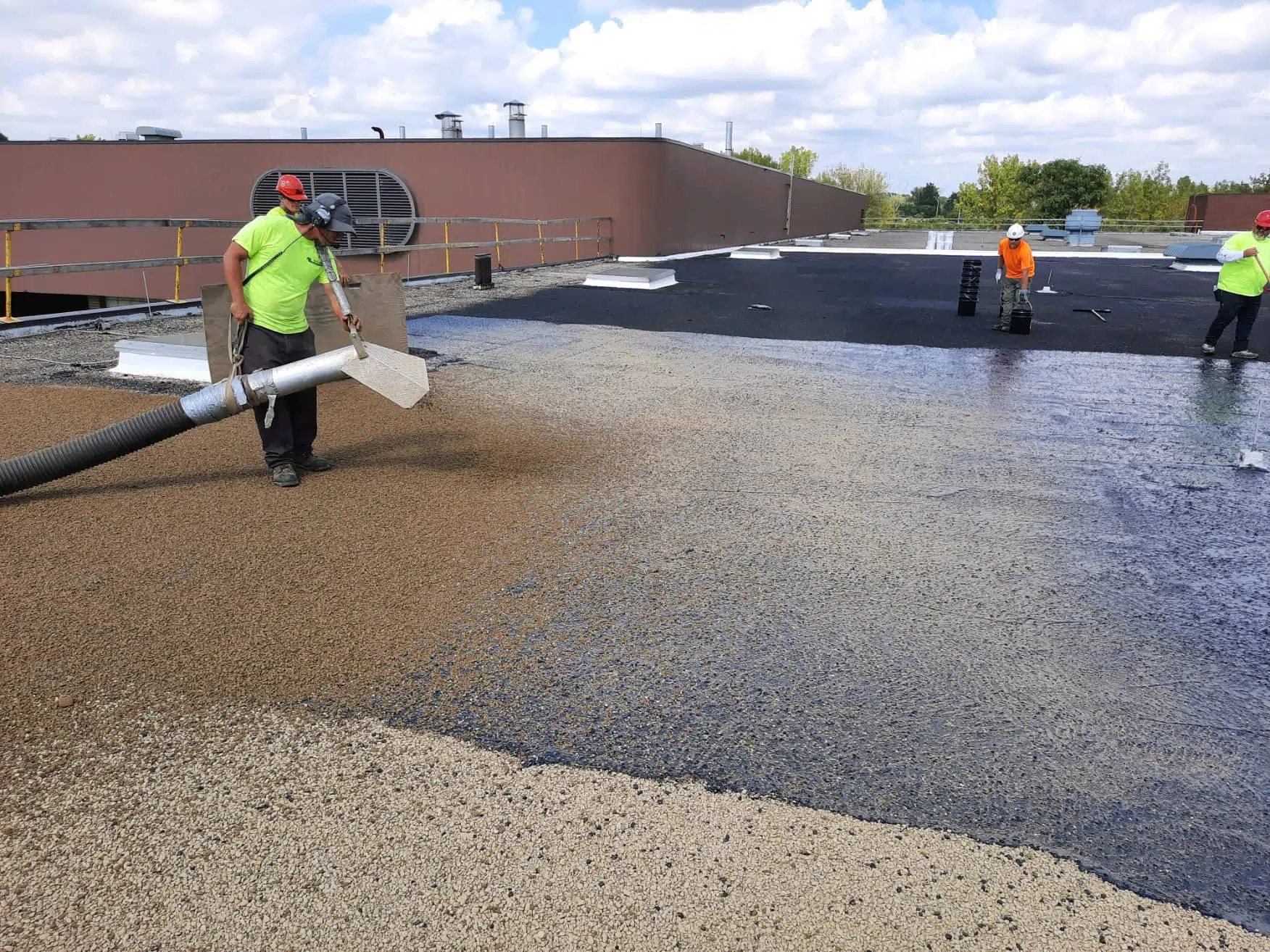
The Las Vegas resort corridor's BUR inventory presents replacement challenges that differ from standard commercial work. Original Strip casino properties have rooftops with decades of accumulated rooftop infrastructure — cooling towers added in subsequent years, communication antenna arrays, satellite uplinks, rooftop mechanical equipment that post-dates the original construction — all of which must be worked around during BUR tear-off without disrupting the property's 24-hour operations. A BUR tear-off generates aggregate debris, interply felt waste, and asphalt residue that must be staged and removed without impacting casino floors, hotel guest areas, or outdoor gathering spaces below.
Resort properties that are replacing original BUR systems also frequently encounter the insulation conditions that decades of Las Vegas operations create: thermal-cycle induced interply movement has created air pathways between plies that allowed years of gradual moisture accumulation in the insulation field, even without visible surface leaks. We budget for infrared scanning and core documentation on every resort BUR replacement before committing to a specific replacement scope — wet insulation extent on a 200,000 sq ft resort podium roof can range from isolated areas to 40%+ of the total field, and the replacement cost difference is substantial enough that discovering the actual condition before contract signing is essential for both parties.
Replacement timing on resort BUR projects is constrained by operational requirements that standard commercial projects do not face. The tear-off and dry-in sequence must be planned in overnight or limited-window production phases on sections of the roof adjacent to occupied guest or gaming floors. A section that is opened at 10 PM must be dried in before the morning hotel operations window opens regardless of the previous day's progress. We build this sequencing discipline into the project schedule before contract execution and staff accordingly — not as a contingency, but as the baseline plan.
The Energy Code Transition from BUR to Cool-Roof Alternatives
Nevada's ASHRAE 90.1-2019 baseline makes BUR-to-BUR replacement-in-kind impractical for most Las Vegas commercial buildings. Standard aggregate-surfaced BUR does not This is not a barrier — it is a code-driven opportunity to improve the building's energy performance at the point when the replacement investment is already committed.
The typical BUR replacement transition in Las Vegas goes in one of two directions: full tear-off and replacement with white TPO or PVC on a new insulation assembly that meets Nevada's R-25 effective minimum, or — where the existing BUR substrate is sound and the insulation is dry — a modified bitumen recover with white granule cap sheet and a silicone topcoat that meets SRI requirements and qualifies for a manufacturer warranty extension. The full replacement path delivers a fresh assembly with a 20-year NDL warranty and documented energy code compliance from day one. The recover path is less expensive and preserves more of the existing R-value, but the warranty term is shorter and the system's remaining life depends on the quality of the substrate underneath.
NV Energy's commercial cool-roof rebate program provides incentive for SRI-compliant replacements that exceed the code baseline. BUR replacement projects that specify white TPO, PVC, or silicone-coated modified bitumen typically qualify. We confirm current rebate program parameters at project scope and produce the documentation required for rebate submission in the project closeout package.
Frequently asked questions
Can you install new BUR on a Las Vegas building today?
Technically yes, but it is rarely the right specification. Hot-asphalt BUR installation in Las Vegas's 115°F summer ambient temperatures requires narrow production windows, careful kettle temperature management, and experienced crews who understand the application constraints. The operational difficulty, the energy code SRI compliance requirement, and the availability of superior warranty-backed single-ply alternatives make new BUR a difficult specification to justify on most Las Vegas commercial buildings. We will tell you directly when it is the right answer and why, and when it is not.
What does it cost to replace an aging BUR system in Las Vegas?
BUR replacement cost depends heavily on wet insulation extent — which we determine with core pulls before any scope commitment — tear-off logistics (aggregate disposal, access constraints on resort properties), deck condition that the tear-off reveals, and the replacement system specified. We do not provide BUR replacement estimates without an on-site assessment that documents actual substrate conditions. The range between a best-case dry-insulation straight-replacement and a worst-case wet-insulation deck-repair project is large enough that a number without core data is not useful.
How long does BUR last in the Las Vegas climate?
Las Vegas BUR systems from the 1970s-90s installation era have demonstrated 30-40+ year lifespans — longer than most manufacturers project in temperate-climate modeling, because the desert's low annual precipitation reduces the moisture intrusion events that are the primary BUR failure driver in wetter climates. The tradeoffs are UV-driven surface oxidation and the dark surface temperature penalty. Systems that have been periodically aluminum-coated have significantly better surface condition than uncoated systems at equivalent ages.
Have an aging BUR system on a Las Vegas commercial building?
We will walk the roof, map moisture with cores or infrared, and produce a written condition report and replacement specification with the options that are genuinely appropriate for your building's substrate condition and capital horizon — including Nevada energy code compliance path and available NV Energy rebate documentation.