
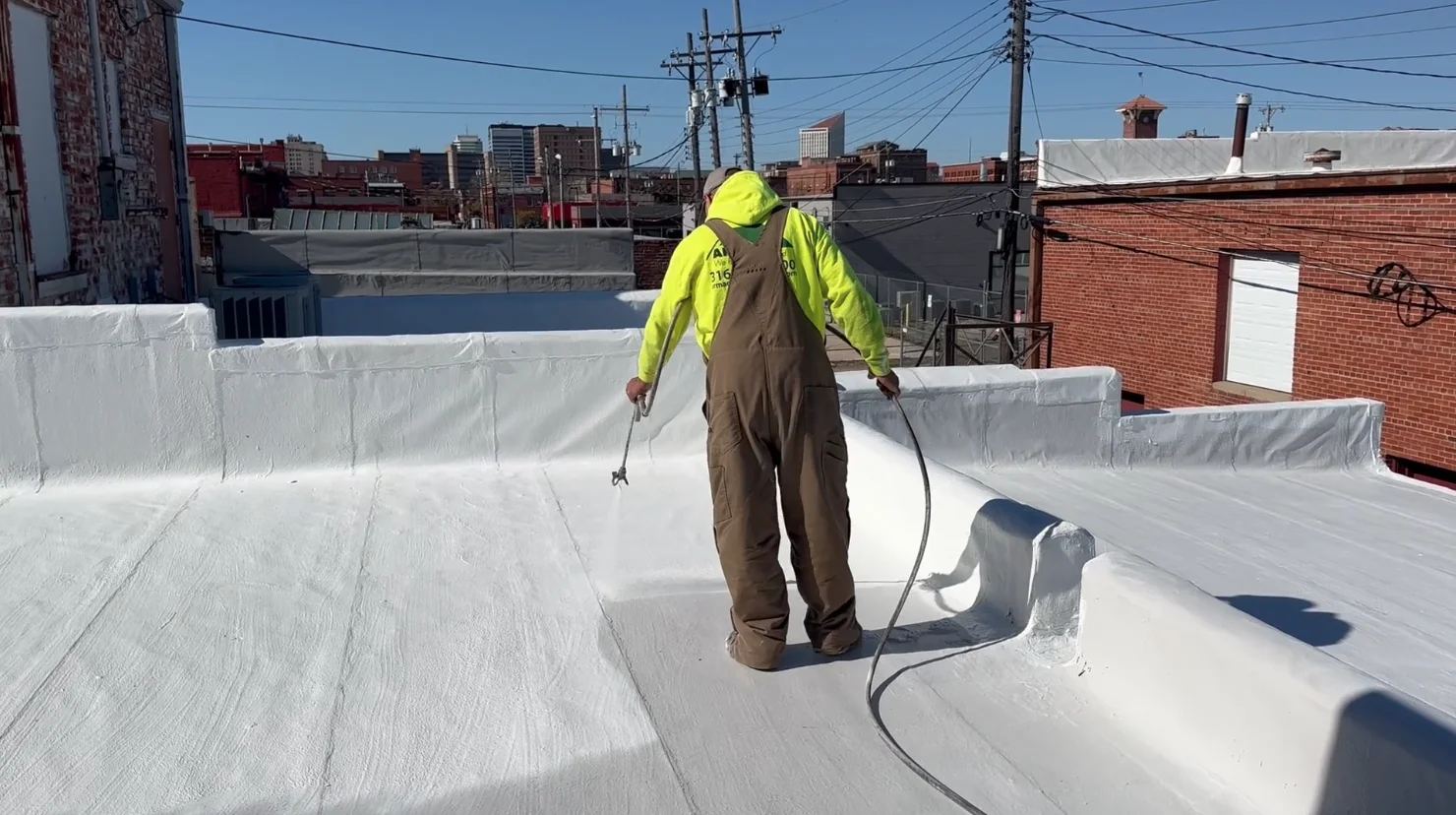
Spray Polyurethane Foam Systems
A practical review of where spray polyurethane foam systems fit the building, budget, and Las Vegas roof conditions.
Seamless Design and the Las Vegas Diurnal Cycle
The 40-55°F daily temperature swing that Las Vegas commercial roofs experience in summer is not an occasional stress event — it is the daily operating condition for every seam, every flashing, and every termination on every flat commercial building in Clark County. A TPO seam weld at the mechanical attachment limit begins each July day near 80°F ambient and ends it near 115°F, then cools back overnight. The seam does not fail on any single cycle; it accumulates fatigue damage across thousands of cycles over years of operation until the weld boundary fails and water intrusion begins. This is why Las Vegas flat roofs fail more often at seams than anywhere else.
SPF's seamless application eliminates this failure mode at the source. The closed-cell foam is not a membrane with seams — it is a continuous monolithic layer that adheres to the substrate and cures into a single interconnected cell structure across the entire roof area. There are no seams to stress, no lap edges to lift, no weld boundaries to fatigue. The foam moves as a unit during thermal cycling, distributing expansion and contraction across the full roof area rather than concentrating it at discrete seam locations. The silicone topcoat applied over the foam adds UV protection and waterproofing redundancy while sharing the same flexibility as the foam beneath.
Flashing conditions — historically the second-highest failure location after field seams on Las Vegas single-ply roofs — are also addressed differently with SPF. The foam is spray-applied into corners, around penetrations, and up parapet faces with the same seamless continuity as the field application. Where TPO requires fabricated corner pieces, termination bars, and overlapping membrane segments at every transition, SPF foam fills these transitions continuously. The result is fewer individual detail conditions to monitor and fewer potential failure initiation points in annual maintenance inspections.
R-Value and Nevada Energy Code Compliance
Nevada's ASHRAE 90.1-2019 baseline requires a minimum R-25 effective insulation value on low-slope commercial roofs. SPF foam delivers R-6 to R-7 per inch of thickness — a 4-inch foam layer provides R-24 to R-28 of effective insulation, meeting the code requirement in a single layer without the insulation board stack that TPO and PVC assemblies require. On buildings where the existing insulation is below the R-25 minimum, an SPF recover simultaneously addresses the insulation deficiency and the membrane replacement without requiring the insulation tear-off that a new single-ply system would necessitate.
The R-value advantage is particularly useful on Las Vegas industrial buildings with original below-code insulation that were constructed before the Nevada energy code adopted the ASHRAE 90.1 baseline. A distribution center from the 1990s may carry R-12 to R-16 existing insulation — compliant at original construction but now below current code. An SPF recover that brings the assembly to R-25 effective addresses the code deficiency, replaces the aging membrane with a seamless system, and qualifies for cool-roof SRI compliance with the silicone topcoat — a three-system improvement in a single project scope.
The silicone topcoat that protects SPF from UV degradation is the SRI-compliant element of the assembly. White silicone topcoats achieve SRI values above 100, meeting the Nevada code minimum and qualifying for NV Energy cool-roof rebates. The topcoat requires renewal every 10-15 years to maintain both UV protection for the foam and SRI performance — we document topcoat renewal requirements in the closeout package and include topcoat inspection in our annual maintenance protocols for SPF buildings.
SPF Application in the Las Vegas Climate
SPF application is more weather-sensitive than single-ply membrane installation. The two-component foam chemistry requires specific ambient temperature, relative humidity, and substrate conditions during application — parameters that fall outside the workable range during Las Vegas monsoon events and that are challenging during peak summer afternoon conditions when substrate temperatures approach the upper limit of the foam's application window. Morning application windows — typically starting at first light and completing the day's foam application before 10 AM to stay below peak substrate temperatures — are standard on Las Vegas SPF projects.
Las Vegas's characteristically low relative humidity is favorable for SPF application. The closed-cell foam chemistry cures better under dry conditions than humid ones, and Clark County's typically 10-25% relative humidity during summer provides favorable curing conditions during the morning application window. The exception is monsoon season (July-September), when afternoon thunderstorm activity raises local humidity and makes afternoon SPF application inadvisable — we schedule SPF application entirely in morning windows during the monsoon period and do not carry open foam applications into afternoon hours when humidity can change rapidly with storm development.
Substrate preparation before SPF application on an existing Las Vegas commercial roof requires moisture confirmation at the surface level as well as the core-pull insulation assessment. Any surface moisture — dew, residual monsoon moisture in roof surface irregularities, HVAC condensate from rooftop units — will prevent proper foam adhesion at the contact point. We confirm surface dryness with a moisture meter before application begins each day, and we do not apply over any section of roof where surface moisture is detected.
Frequently asked questions
How long does an SPF roof last in Las Vegas conditions?
The foam substrate can last 30-40 years or more in Las Vegas conditions when the silicone topcoat is maintained. The topcoat requires renewal every 10-15 years — it is the UV protection layer for the foam beneath, and UV Index 10+ year-round in Las Vegas means topcoat inspection and timely renewal is not optional. Buildings on our maintenance contracts get topcoat condition documented at each annual inspection so renewal is planned rather than reactive.
Can SPF be applied over an existing single-ply membrane?
Yes, if the existing membrane is dry, has sound adhesion to the substrate, and passes a surface moisture check at application time. Core pulls confirm insulation condition — wet insulation beneath the existing membrane is a replacement item before SPF application can proceed. An SPF recover over a qualifying dry TPO or modified bitumen surface eliminates the cost of tear-off and disposal while delivering a seamless new waterproofing and insulation layer.
Does SPF with silicone topcoat meet Nevada's energy code?
Yes. White silicone topcoats achieve SRI values above 100, meeting Nevada's ASHRAE 90.1-2019 SRI requirement. The foam layer delivers R-value consistent with the Nevada R-25 effective minimum at appropriate installed thickness. We document both SRI and R-value compliance in the project closeout file and confirm the assembly against current code requirements.
Is SPF affected by Las Vegas monsoon humidity?
SPF application cannot proceed during or immediately after monsoon events when surface moisture is present or when ambient humidity has risen significantly above Clark County's typical range. We schedule all foam application in morning windows during monsoon season and confirm surface dryness with a moisture meter before beginning each application session. No foam is applied over any surface showing moisture detection, without exception.
Evaluating SPF for a Las Vegas commercial building?
We will walk the roof, pull cores to confirm existing insulation condition, and produce a written SPF specification with R-value calculation, SRI documentation, NV Energy rebate eligibility, and a lifecycle cost comparison against single-ply alternatives.