
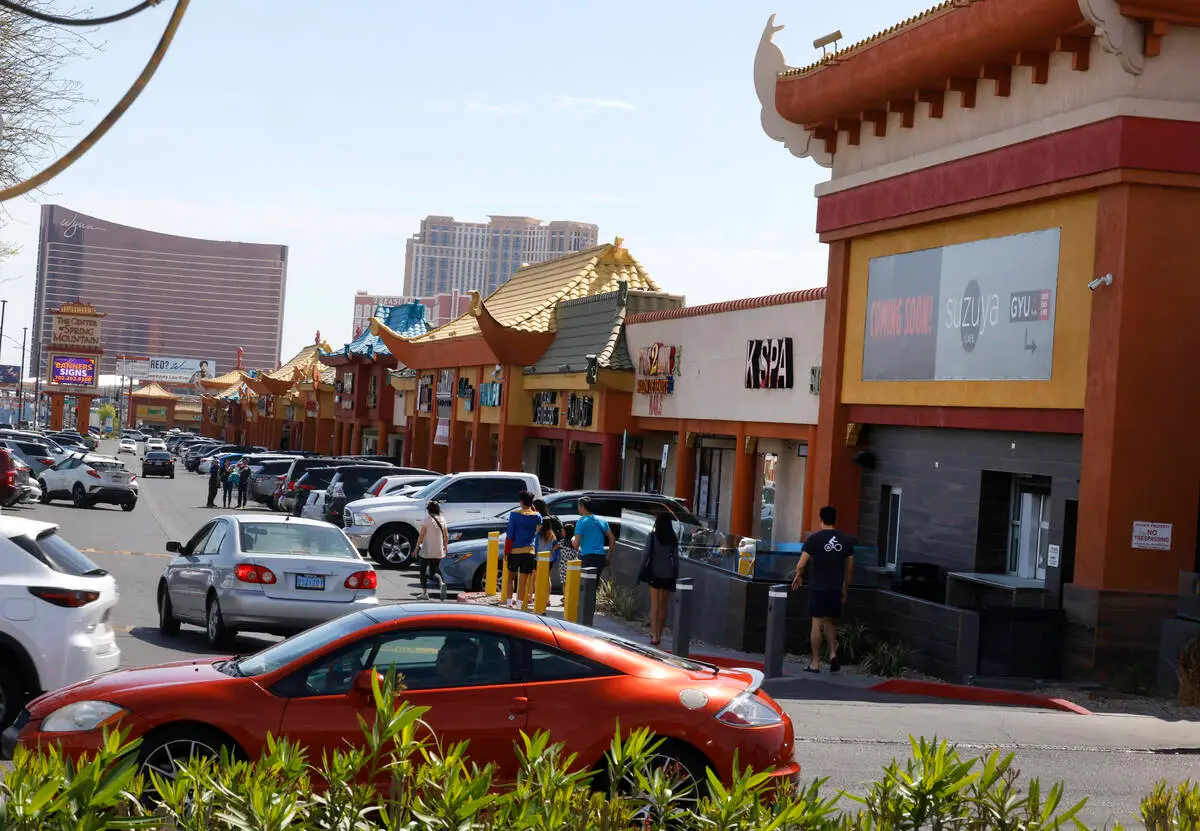
Commercial Roofers in Chinatown Spring Mountain, NV
Commercial roofing in Chinatown Spring Mountain, NV should begin with a documented assessment of membrane condition, seams, flashings, drainage, penetrations, and moisture before repair, coating, or replacement is selected. Commercial roof repair, inspection, coating, and replacement planning for Chinatown Spring Mountain properties.
Strip Retail Center Roofing: End-of-Life Assessment on the Spring Mountain Corridor
The 1993-2002 Spring Mountain Road strip retail inventory presents a consistent failure picture: 45-mil TPO or modified bitumen APP membrane installed at the time of original construction, with 20-30 years of Mojave UV exposure, minimal maintenance history, and ponding at drain areas that were undersized for monsoon drainage volumes from the beginning. We inspect these roofs with a specific checklist: membrane surface UV-condition (chalking, brittleness, elongation loss), seam weld integrity along the full field, flashing adhesion at parapet caps and equipment curbs, drain body condition and drain collar-to-membrane bond, and insulation saturation at drain zones via core pull.
The strip retail building type on Spring Mountain has a characteristic roof shape that creates a predictable ponding pattern: the main retail bay runs deep behind the storefront parapet, sloping toward interior drains, with a small mechanical penthouse or equipment curb cluster near the center of the roof. The equipment curbs interrupt the drainage slope and create low-point accumulation zones on the downslope side of each curb. We see this ponding pattern consistently and address it with tapered polyiso insulation in the reroof specification - adding slope to drain around each equipment curb rather than leaving the ponding-prone geometry intact.
Multi-tenant ownership structures on Spring Mountain mean that cost recovery for roofing capital is frequently a landlord-tenant negotiation, not a simple owner decision. Some tenants have triple-net lease structures that include roof maintenance obligations; others are on gross leases where the landlord carries the full roof obligation. We do not participate in the lease dispute - we execute whatever scope the landlord authorizes and provide documentation to all parties that confirms what work was performed, when, and to what specification. That documentation package is often the operative record in a subsequent lease negotiation.
Restaurant and Food-Service Buildings: Chemical and Grease Load Management
Spring Mountain Road's concentration of Asian restaurants - the highest density of Chinese, Japanese, Korean, Vietnamese, and Southeast Asian dining destinations in Nevada - creates a restaurant-exhaust chemical load on commercial rooftops that is unusually heavy per linear foot of corridor. Commercial kitchen exhaust from dim sum restaurants, ramen shops, hot-pot establishments, and Korean barbecue operations introduces a particularly aggressive grease-and-smoke aerosol load on nearby membrane surfaces. We consistently find accelerated membrane degradation in 10-to-20-foot radii around kitchen exhaust outlets on the buildings in this corridor.
Our membrane specification in restaurant-concentration zones on Spring Mountain defaults to PVC for chemical resistance in the exhaust-proximity zone, with silicone fluid-applied coating as an alternative for recover-grade situations where the existing membrane has sound adhesion but is showing exhaust-zone degradation. We install custom exhaust-hood diverter extensions on rooftop kitchen exhaust outlets during replacement scopes to redirect the discharge stream away from the membrane field - a detail that significantly extends service life in the zones immediately surrounding the exhaust point.
Rooftop grease accumulation is also a fire-code issue, not just a membrane-degradation issue. Clark County Fire Department inspections of commercial kitchen rooftops include assessment of grease accumulation on exhaust hood exteriors and on the roof membrane in proximity to exhaust outlets. We document grease accumulation zones during our inspection process and note them in the condition report - the facilities manager needs to know about a grease accumulation finding before the next fire inspection, not after.
Spring Mountain Road Permit Jurisdiction and Build-Out History
Spring Mountain Road west of I-15 falls within Clark County jurisdiction for most of its length through the Chinatown corridor, with a smaller portion falling within the City of Las Vegas city limits near the eastern end near Valley View Boulevard. The permit jurisdiction boundary matters because the Clark County Building Department and the City of Las Vegas Building and Safety Department have different permit intake processes, different energy code documentation requirements at submission, and different inspection timelines. We confirm jurisdiction at every Spring Mountain property before pulling the permit and advise the building owner which AHJ applies.
The original Chinatown Plaza at 4255 Spring Mountain Rd was developed in 1995 and represents the prototype for the Spring Mountain commercial format - a medium-depth retail center with a covered arcade walkway, an Asian grocery anchor, and smaller restaurant and retail bays. The arcade walkway creates a covered-outdoor zone between the storefronts and the parking lot that complicates material staging and crane placement. We work material lifts through the open sections of the parking lot and coordinate staging with the center manager to maintain pedestrian access through the arcade during production.
The newer developments along Spring Mountain Road - Spring Mountain Ranch at the west end, the 2010s-era infill retail buildings near Decatur - are in first maintenance cycles rather than replacement territory. For these buildings, our work is primarily warranty compliance inspections, pre-monsoon drainage checks, and post-storm condition assessments. The replacement volume on Spring Mountain is concentrated in the 1993-2005 construction vintage that covers the majority of the corridor's strip retail square footage.
Frequently asked questions
Can you work on buildings while restaurants are operating on Spring Mountain Road?
Yes. We confirm operating hours with each tenant before writing the production plan. For 7-day restaurant operations, we schedule noise-generating work (tear-off, generator operation) outside the tenant's quiet-hours window and maintain access to loading and delivery areas during the tenant's service-vendor windows. Production on active restaurant buildings takes longer than vacant buildings - we build those schedule impacts into the project timeline.
What membrane do you specify near kitchen exhaust outlets?
PVC in the exhaust-proximity zone - typically a 15-to-20-foot radius around each exhaust outlet, adjusted based on exhaust volume and prevailing wind direction. PVC is significantly more resistant to grease-laden aerosol chemical contact than TPO or EPDM. We also install rooftop exhaust-diverter extensions during replacement scopes to redirect discharge away from the membrane field.
Do you handle both Clark County and City of Las Vegas permits for Spring Mountain Road properties?
Yes. The Chinatown corridor straddles both jurisdictions. We confirm which AHJ applies to each property before pulling the permit, and we manage the intake process for both Clark County and City of Las Vegas commercial roofing permits. The documentation requirements differ between the two offices - we deliver the correct package to the correct AHJ.
How do you handle rooftop access and staging at the Chinatown Plaza arcade buildings?
Covered arcade walkways restrict crane placement and material lift locations at Chinatown Plaza and similar buildings. We work lifts through open parking-