Commercial Roofers in Lone Mountain, NV
For commercial properties in Lone Mountain, NV, the defensible choice between repair, restoration, and replacement starts with roof-system condition, moisture findings, drainage performance, and remaining service life. Commercial roof repair, inspection, coating, and replacement planning for Lone Mountain properties.
Neighborhood Strip Retail: Portfolio Assessment and Capital Planning
Lone Mountain's strip retail buildings share a consistent construction profile: single-story, wood-frame or CMU construction with a flat parapet roof, original modified bitumen or early-generation TPO installed between 1993 and 2003, and 20-to-30-year-old drain bodies that were undersized at installation for the monsoon drainage volumes they now receive. The condition we find on these roofs at inspection is predicable enough that the pre-inspection conversation with a building owner often gives us a reasonable forecast before we step on the roof: visible surface chalk and brittleness, open seams at parapet flashing transitions, and ponding rings around the drains from years of inadequate drainage.
Property management firms that own clusters of Lone Mountain strip retail buildings benefit from portfolio-level roofing analysis rather than building-by-building reactive scoping. We write multi-building portfolio assessments that evaluate every building in a northwest Las Vegas portfolio in a single inspection cycle, rank them by urgency and capital need, and produce a five-year capital planning schedule that allows the owner to budget for replacement on the highest-urgency buildings now and plan financing for the next tier. Portfolio assessment spreads the inspection cost across multiple buildings and produces a planning document that is useful for financing applications, insurance renewals, and property sale due diligence.
Grocery-anchored centers in the Lone Mountain area - smaller neighborhood grocery formats like Cardenas and Fiesta - present roofing considerations driven by the refrigeration loads of the anchor tenant. Walk-in cooler and freezer condensing units on the rooftop generate a substantial vibration and mechanical load that stresses the membrane and flashings in the equipment zone more aggressively than standard HVAC. We assess refrigeration equipment zones specifically during grocery-building inspections and specify heavier flashings and improved curb details in those zones during replacement scopes.
Medical and Dental Office Buildings in Lone Mountain
The Lone Mountain area's proximity to established neighborhoods generates significant demand for neighborhood medical and dental services - primary-care physician offices, dental practices, urgent-care clinics, and outpatient physical therapy are all represented in the commercial nodes along Lone Mountain Road and Rancho Drive. These buildings are typically 3,000-to-10,000 square feet, single-story, with rooftop HVAC and medical gas vent penetrations that add complexity relative to standard retail.
Medical-office buildings in the Lone Mountain area do not carry the infection-control, ICRA-classification, and helipad-coordination requirements that acute-care hospital campuses require. But they do have patient-scheduling constraints that affect production windows. A dental office that books appointments through 5 PM six days a week cannot accommodate overhead noise during practice hours without disrupting the patient experience. We confirm practice hours before writing the production schedule and use early-morning production windows that complete noise-generating operations before the first patient appointment.
Rooftop medical gas vent stacks - oxygen and nitrous oxide venting from dental and medical suites - are penetrations that require specific flashing details. The vent stacks are typically rigid pipe extending above the roofline, with pitch pans or prefabricated flashing boots at the roof penetration. These flashings are among the highest-frequency maintenance items on medical-office buildings because the thermal cycling stress on a rigid pipe penetration is significant, and the pitch pan fills used on older installations degrade rapidly in Mojave Desert UV conditions. We document every medical gas vent penetration and its flashing condition in every Lone Mountain medical-office inspection report.
Peccole Ranch and Lone Mountain Neighborhood Commercial Interfaces
Lone Mountain and the adjacent Peccole Ranch planned community share commercial corridors that sit at the boundary of neighborhood and commercial zoning - a spatial relationship that creates access and staging constraints that inland industrial buildings do not face. Strip retail centers adjacent to neighborhoods have parking lots that serve double duty as resident cut-through routes, residents directly adjacent to rear-parcel loading areas who have noise sensitivity, and HOA expectations about construction appearance and cleanliness that add a community-relations dimension to standard commercial roofing work.
We treat neighborhood-adjacent commercial projects with explicit neighbor-notification and site-cleanliness protocols. Pre-construction: we deliver a project notification to adjacent property owners that describes the work scope, anticipated schedule, and the name and phone number of our project manager as the on-site contact. During production: debris containment nets, end-of-day dumpster-lid closure, and parking-lot sweep before crew departure. After production: a site walk with the building manager and a written confirmation to adjacent neighbors that the project is complete and site conditions are restored. These are not optional additions on neighborhood-adjacent sites - they are standard protocol.
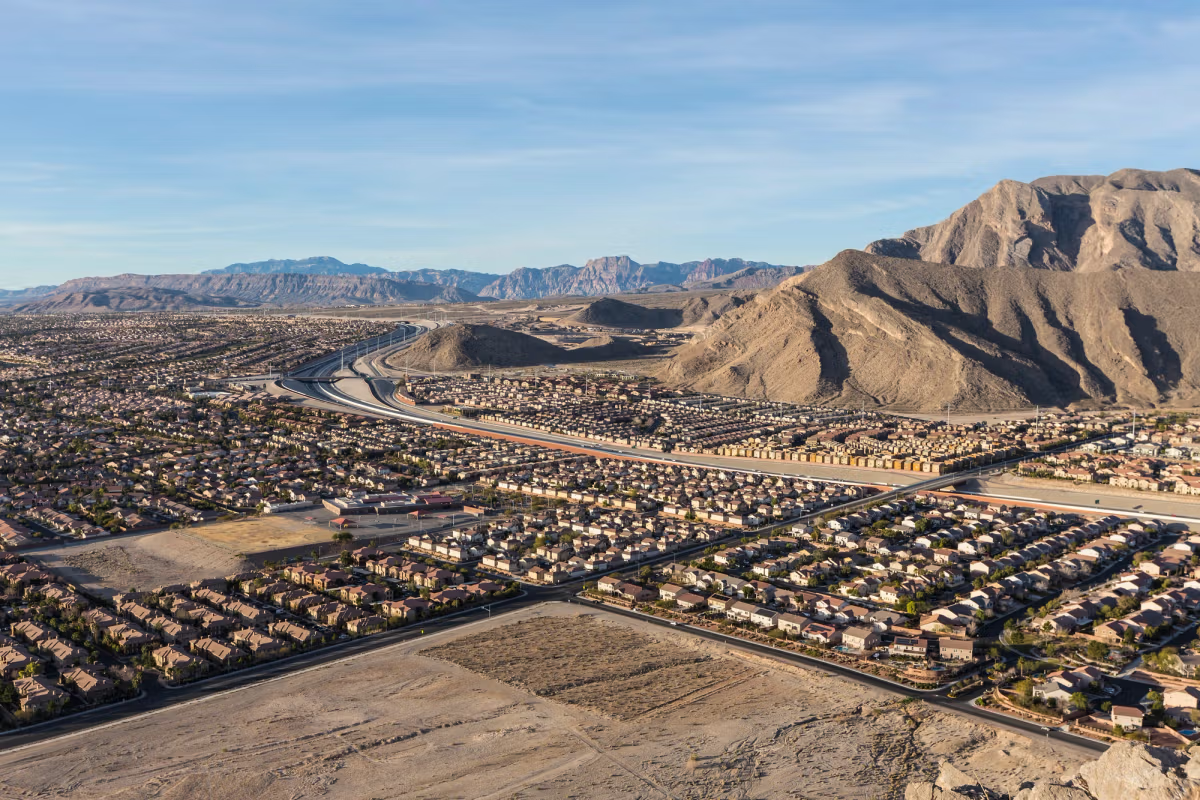
The Lone Mountain Regional Park at the east base of Lone Mountain provides a visual context for the commercial development immediately adjacent. The park is a significant community asset, and commercial projects visible from the park trail system draw a higher level of public attention than equivalent projects in an industrial corridor. We maintain a clean and orderly job site on all Lone Mountain commercial projects as a baseline standard - not as a special accommodation.
Frequently asked questions
Can you manage a multi-building portfolio of Lone Mountain strip retail centers?
Yes. We write multi-building portfolio assessments and multi-building maintenance contracts for northwest Las Vegas commercial property portfolios. The portfolio assessment evaluates every building in a single inspection cycle, ranks urgency, and produces a five-year capital planning document. The maintenance contract covers all buildings under one agreement with a unified inspection schedule and reporting cadence.
What permit jurisdiction covers Lone Mountain commercial buildings?
Most of the Lone Mountain commercial inventory falls under Clark County Building Department jurisdiction - not the City of Las Vegas. We confirm jurisdiction for each building before pulling the permit and manage the Clark County commercial roofing permit intake, energy code documentation submission, and inspection coordination.
Do you work on medical and dental office buildings in the Lone Mountain area?
Yes. Medical and dental offices have patient-scheduling constraints that affect production windows. We confirm practice hours before writing the production plan and schedule noise-generating operations for early-morning windows before the practice opens. We also inspect and document every medical gas vent penetration and its flashing condition as part of the standard inspection report.
How do you handle roofing projects adjacent to neighborhoods?
We deliver pre-construction notifications to adjacent neighboring property owners, maintain debris containment and end-of-day cleanup discipline throughout production, and complete a post-production site walk with the building manager before closing the project. These are standard protocol on neighborhood-adjacent sites, not add-ons.