
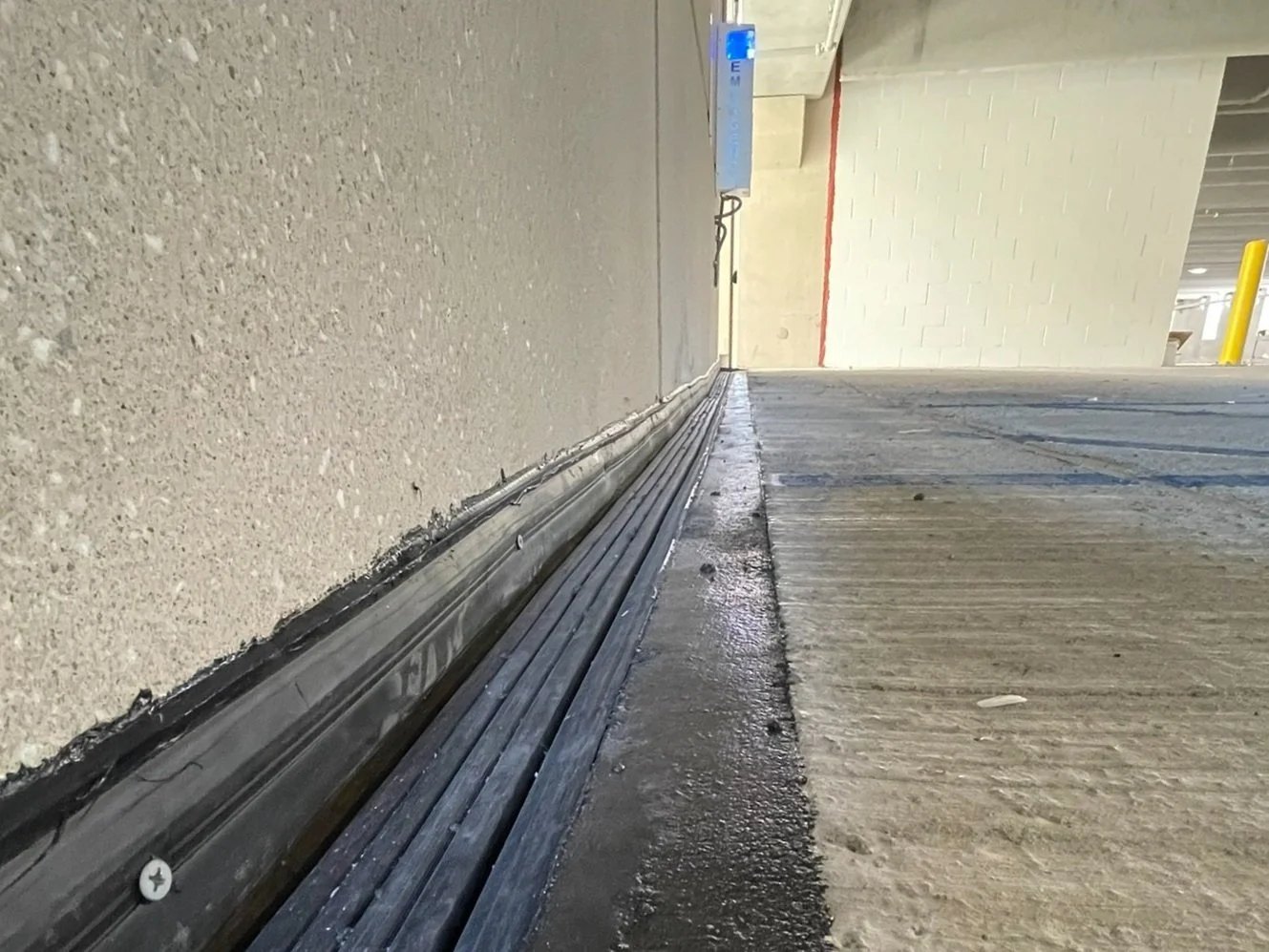
Expansion Joint Repair
Documented roof planning for expansion joint repair across Las Vegas commercial facilities.
EPDM and TPO Expansion Joint Cover Systems
EPDM bellows covers are the most common system on Las Vegas commercial buildings constructed through the 1990s. The bellows — a flexible loop of EPDM that spans the joint opening — accommodates horizontal movement by extending and compressing as the joint opens and closes. The cover is mechanically terminated on both sides of the joint with metal termination bars embedded in the surrounding roofing membrane. When the bars pull out of the membrane, the cover fails. When the bellows material hardens through UV degradation and plasticizer loss, the cover tears rather than flexing under the next thermal expansion cycle.
TPO heat-weldable expansion joint covers — offered by Carlisle, Johns Manville, Versico, and other TPO manufacturers — are the current standard specification on Las Vegas buildings with TPO membrane systems. The cover is heat-welded to the field membrane on both sides of the joint, with a pre-formed TPO bellows spanning the gap. Because the joint between the cover and the field membrane is a weld rather than a mechanical bar, it integrates cleanly with the membrane and eliminates the termination bar as a failure point. On Las Vegas buildings where we are replacing an aging EPDM bellows cover on an existing TPO system, we typically specify the TPO heat-weldable cover so the entire assembly is a single membrane type with a single failure-mode set.
Modified bitumen-compatible preformed covers are used on existing BUR or modified bitumen systems where a torch-applied or hot-mopped integration is required. These systems are less flexible than single-ply bellows covers and require conservative movement range sizing — if the cover is undersized for the actual Las Vegas thermal cycling range, it tears at the center within the first summer. We measure before we specify.
Sizing for Las Vegas Thermal Cycling
The engineering requirement for expansion joint covers in Las Vegas differs from most markets because the local thermal cycling is so extreme. A standard EPDM bellows cover sized for a 1-inch joint in a Mid-Atlantic climate may be rated for 50% expansion and 30% compression — adequate for a market with 20°F diurnal swings. In Las Vegas, where the same joint experiences 40 to 55°F daily swings, a cover rated to those temperate-market parameters is operating at or beyond its design limit every day.
We measure the joint width in the early morning — when ambient temperatures are lowest and the joint is at its widest thermal state — and again in mid-afternoon when the roof surface has reached peak temperature and the joint is at its narrowest. The difference between these measurements is the daily thermal movement range that the cover must accommodate. We add a safety factor and specify a bellows cover whose rated movement range exceeds this measured value. This step takes thirty minutes and prevents specifying a cover that will fail within two summers.
We also assess the horizontal profile of the joint. Joints that are wider on one end than the other, or that show evidence of progressive differential movement over time, may indicate ongoing structural movement beyond simple thermal cycling — building settlement, foundation issues, or long-term lateral movement from wind load. When we find this pattern, we document it and discuss it with the building owner before specifying a cover, because no cover system will perform adequately over a joint with uncontrolled progressive movement.
When to Repair vs. Replace the Cover System
Cover repair — patching a torn bellows section, re-terminating a pulled termination bar, reseating a displaced cover — is appropriate when the failure is isolated and the remaining cover material retains adequate flexibility and thickness. We probe the EPDM or TPO cover material at the repair location and at representative points along the joint to confirm the material is not so UV-degraded that a patch will fail within the next season.
Full cover replacement is the correct scope when the bellows material has hardened or cracked across most of its length, when the termination bars have separated from the surrounding membrane over more than 30% of the joint, or when the joint has experienced significant width change from the original specification — a condition that can occur on Las Vegas buildings where the combination of extreme thermal cycling and building settlement has moved adjacent structure beyond the original design intent.
We do not fill expansion joints. A joint filled with urethane caulk, spray foam, or any rigid material becomes a fixed point in the membrane that tears at the next significant thermal expansion event. We see this on Las Vegas buildings where a prior contractor applied caulk or foam across an expansion joint to stop an active leak — the fill bonds to both sides of the joint, fails when the joint opens, and tears the surrounding membrane at the same time. The repair for a filled joint requires removing the fill material, restoring the joint gap, and installing a proper bellows cover system. It is always more expensive than installing the bellows cover in the first place.
Frequently asked questions
How do I know if a membrane crack is at an expansion joint versus a random field crack?
Expansion joint failures follow the structural joint exactly — they run in a straight line parallel to a visible roofline transition or a break in the building's exterior wall. Field membrane cracks follow random paths determined by local stress concentrations, seam lines, and areas of settlement. A linear crack that tracks a building joint is almost certainly at an expansion joint and warrants a bellows cover, not a field repair.
My Las Vegas building was built in 1992 and I have recurring cracks at the same location. Could this be an expansion joint problem?
Yes. Buildings from that era that were constructed without roofing expansion joints, or with undersized joint gaps, often develop recurring membrane cracks at structural transitions as the thermal cycling stress accumulates over decades. In Las Vegas, that stress accumulates faster than in most markets. If the cracking recurs at the same location after repeated patching, the correct long-term solution is likely a bellows cover installed retroactively at the structural transition.
Can expansion joint covers be installed without a full reroof?
Yes, in most cases. The cover system is terminated into the existing membrane on both sides of the joint — mechanically with bars and sealant on EPDM systems, by heat weld on TPO systems. We require that the surrounding membrane be in sound condition within approximately two feet of the joint on each side. Installing a bellows cover over deteriorated membrane transfers the failure mode from the joint to the membrane edges of the new cover.
How long do expansion joint covers last in Las Vegas?
EPDM bellows covers on Las Vegas commercial buildings typically show material degradation at 10 to 15 years — shorter than the 15 to 20 year life they achieve in temperate markets, because of the daily thermal cycling and UV exposure. TPO heat-welded covers on new TPO systems generally track the surrounding membrane's service life. Covers on buildings with movement ranges at or near the top of the rated specification will fail earlier than covers on buildings where the joint movement is well within the cover's design range.