
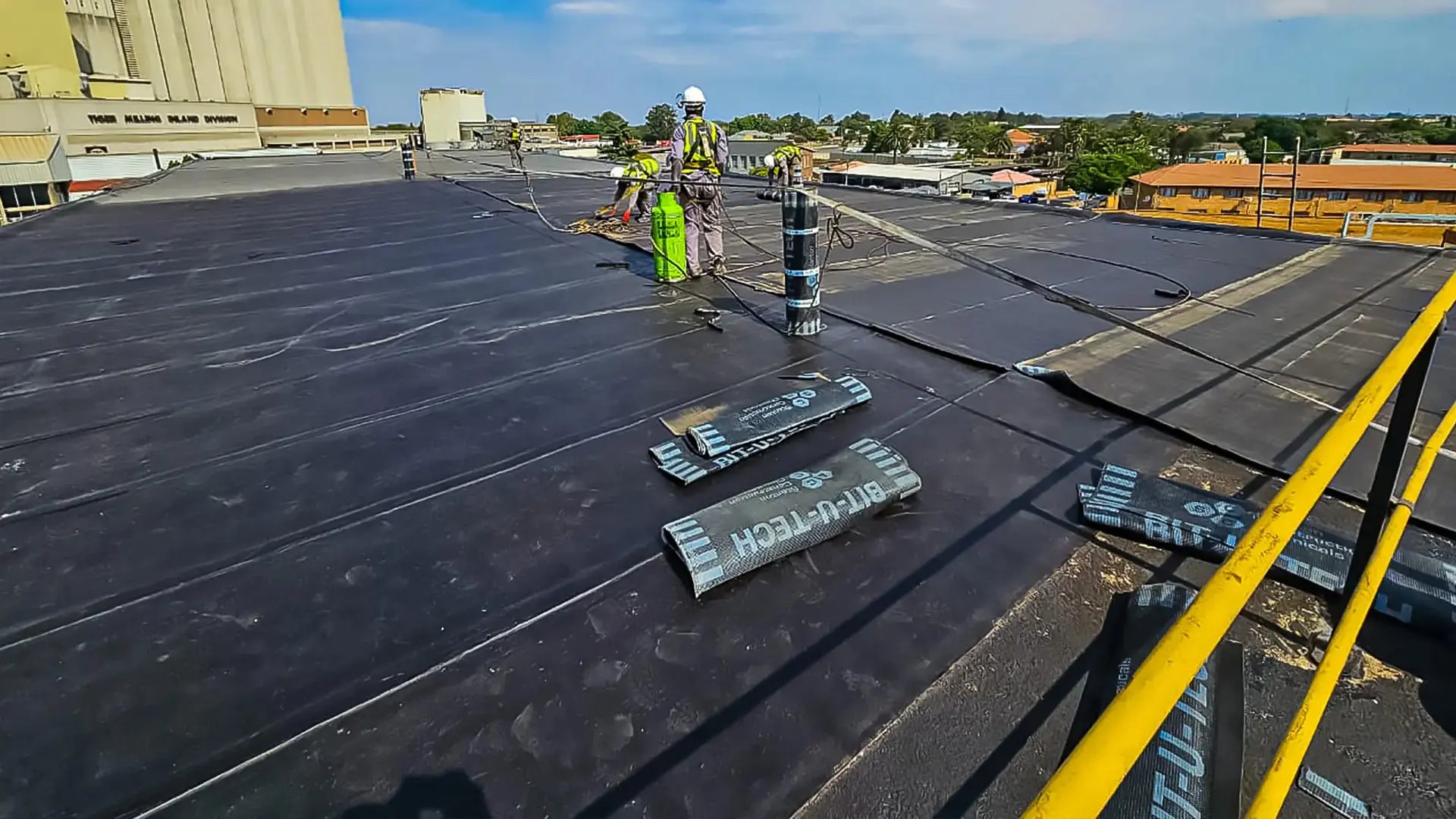
Modified Bitumen Roofing
Documented roof planning for modified bitumen roofing across Las Vegas commercial facilities.
Where Modified Bitumen Makes Technical Sense in Las Vegas
Recover over existing built-up roofing (BUR): Las Vegas has a significant inventory of original 1970s and early-1980s commercial buildings — portions of the Downtown Fremont Street corridor, older Clark County commercial buildings predating the TPO era — running original gravel-surface BUR systems. Where core pulls confirm dry insulation, a modified bitumen cap sheet recover over the existing BUR base is often the most cost-effective life extension option. The new cap sheet bonds to the existing system without full tear-off, preserving the existing base and avoiding disposal of a functioning substrate.
Small and penetration-dense roofs: A Las Vegas commercial building with dozens of HVAC curbs, exhaust fans, conduit sleeves, and kitchen exhaust penetrations can be detailed more efficiently in modified bitumen than in single-ply, where each penetration requires a separately fabricated flashing component. Roofs under 5,000 sq ft with high penetration density are frequently the right application for self-adhered SBS, particularly where the building's configuration makes membrane welding equipment difficult to maneuver.
Cold-storage and temperature-differential buildings: Las Vegas has a meaningful cold-storage footprint serving the resort corridor's food distribution requirements and the broader Clark County grocery and perishables logistics network. Low-slope roofs over cold storage where the temperature differential between interior and exterior is extreme — sub-freezing interior space adjacent to 110°F ambient exterior — produce unusual vapor drive conditions that modified bitumen's multi-ply construction handles more reliably than thin single-ply membranes.
Where Single-Ply or Silicone Outperforms Modified Bitumen in Las Vegas
Large warehouse and distribution buildings: The I-15 industrial corridor north of downtown, the North Las Vegas Apex industrial zone, and Henderson's I-215 Beltway industrial buildings are large-format single-story projects where mechanically attached TPO installs faster, costs less per square, and carries equivalent warranty terms compared to torch-applied modified bitumen. The thermal reflectivity advantage of white TPO also matters significantly in Nevada's cooling-dominated climate — a granulated cap sheet that cannot
Cool-roof energy code compliance: Nevada's ASHRAE 90.1-2019 SRI requirements are difficult to White-granule modified bitumen cap sheet is available but adds material cost and is less readily sourced in the Las Vegas market. White TPO meets code as the standard product. For projects where energy code compliance is required — which is most new commercial work in Clark County — single-ply is the more straightforward specification path.
Summer production scheduling: Torch-applied operations during July and August in Las Vegas require careful heat-stress management for crews and limit production window length as surface temperatures peak. Self-adhered cold-applied systems avoid the torch constraint but are slower per square than heat-welded TPO. For large-format summer production schedules, TPO's combination of faster installation and cooler working conditions is a practical advantage.
Torch-Applied Modified Bitumen Hot-Work Permitting in Clark County
Torch-applied work in Las Vegas requires hot-work permits through the City of Las Vegas Fire Prevention Bureau or the Clark County Fire Department, depending on jurisdiction. The permit process is manageable but adds pre-construction lead time. Resort and casino properties operating under Clark County jurisdiction have facility-specific hot-work permit protocols managed through their internal safety departments — we coordinate the permit application and pre-work fire watch inspection with the property's safety officer before crew mobilization on every torch-applied project.
On occupied buildings — including gaming floors, hotel towers, and medical facilities — hot-work permits require review and approval from the building's safety officer, not just the fire authority. This approval process can add 5–10 business days to project pre-construction on larger resort and institutional accounts. Self-adhered cold-applied systems eliminate this step entirely, which is why they are specified on many Las Vegas occupied building projects regardless of other technical factors.
Frequently asked questions
Can an existing Las Vegas modified bitumen or BUR roof be recovered without full tear-off?
Yes, if core pulls confirm dry insulation and the existing base plies are adhered well enough to provide a stable substrate. A self-adhered SBS cap sheet recover over an existing granulated BUR base is a common project type on the older Las Vegas commercial inventory. Tear-off is required when existing insulation is saturated — we verify with cores before proposing any recover option.
Is torch-down modified bitumen safe on an occupied Las Vegas commercial building?
Yes, when done properly. We pull hot-work permits through the relevant Clark County or city fire authority, conduct a pre-work fire watch inspection with the building's facility manager, and maintain a fire watch for the post-torch period required by code. On resort and casino properties, we coordinate the hot-work permit with the property's internal safety department before mobilization. Self-adhered systems are an alternative that eliminates the permitting step entirely on buildings where the facility manager has restricted open-flame operations.
What warranty is available on modified bitumen roofing in Las Vegas?
15-year NDL warranties are standard on two-ply SBS modified bitumen systems from manufacturers such as GAF, Johns Manville, and Soprema. 20-year NDL is available on premium SBS cap sheet specifications from select manufacturers. All NDL warranty programs require documented periodic inspection — the same manufacturer documentation requirement that applies to TPO and EPDM NDL programs.