
Services

Restaurant and Food Service Building Roofing in Las Vegas, NV

Commercial roofing for restaurants, quick-service chains, breweries, and food service facilities throughout Las Vegas, NV.

Commercial roofing for restaurants, quick-service chains, breweries, and food service facilities throughout Las Vegas, NV.

Las Vegas runs its restaurant economy twenty-four hours a day, which means the roofs above its food service buildings never get a rest period. The Strip's casino-integrated restaurants, the fast-casual corridor along Sahara Avenue and Charleston Boulevard, and the independent restaurant cluster emerging in the Arts District all share the same fundamental challenge: a membrane and penetration system that must perform through 115-degree summers, occasional freezing nights, and the relentless UV radiation that bakes the Mojave Basin ten months of the year. There is no forgiving wet season to mask slow leaks or hide deteriorating sealants — Las Vegas roof failures show up as immediate interior damage because the building envelope has no redundancy against the heat-driven pressure differentials that push air through every gap.

Grease exhaust management on Las Vegas restaurant roofs differs from most U.S. markets because of the sheer volume of cooking happening in concentrated areas. A single casino hotel food court might run eight to twelve separate restaurant concepts, each with its own exhaust stack penetrating the roof. Managing the cumulative grease deposit pattern across that kind of penetration density requires a documented maintenance protocol that identifies each stack, assigns it to an operating concept, and schedules cleaning based on that concept's cooking load. Roofing contractors who service Las Vegas restaurant properties without that documentation are essentially guessing about which exhaust penetrations are active and which are abandoned, which creates both safety hazards and missed maintenance targets.

The Mojave's extreme UV index is the single biggest contributor to premature membrane aging on Las Vegas restaurant roofs. Standard 45-mil TPO membranes in this environment can show surface chalking and brittleness within seven to eight years, well short of the advertised service life. Specifying 60-mil or 80-mil membranes with higher UV stabilizer content, or selecting a reflective white-surface PVC with enhanced UV inhibitors, is not a luxury upcharge in Las Vegas — it's the baseline required to reach a reasonable service life. Roofing warranties in Nevada's climate are also most meaningful when the manufacturer has service history data from local projects, not just lab test results.

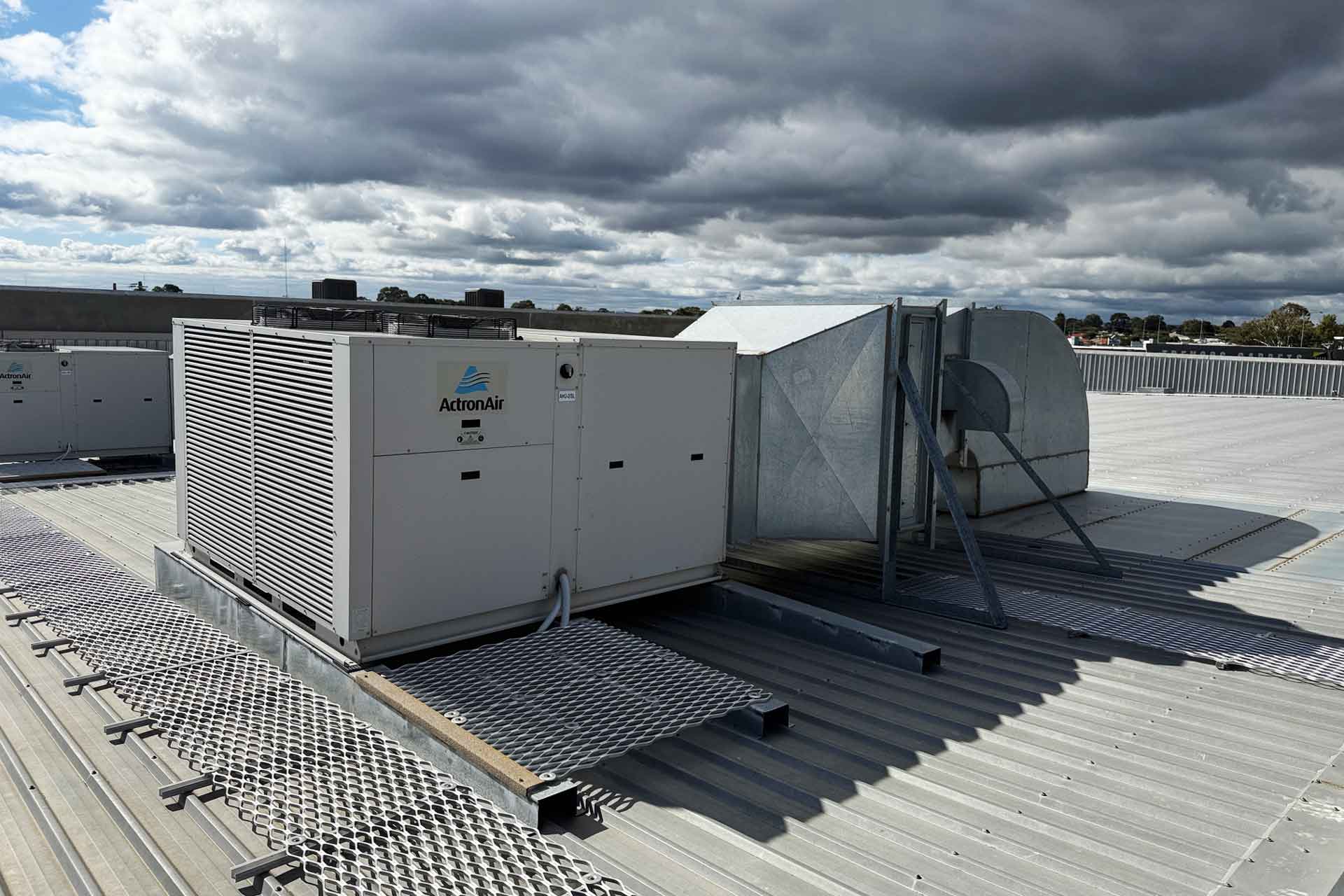
Walk-in cooler and freezer systems on Las Vegas restaurant roofs work harder than almost anywhere else in the country. Ambient air temperatures in July and August that regularly exceed 110 degrees Fahrenheit force refrigeration compressors to run extended cycles, generating substantial waste heat at the condenser unit. The membrane directly around condenser discharge grilles on Las Vegas restaurant roofs can reach temperatures that exceed the service rating of standard single-ply materials during peak summer afternoons. Installing radiant barriers and additional cover board beneath condenser curbs, combined with painted aluminum protective coatings in the immediate discharge zone, is the Las Vegas-specific detail that separates a well-specified system from a generic regional specification that will fail early.

Las Vegas health code requirements for commercial kitchens are enforced by the Southern Nevada Health District, which conducts unannounced inspections across the city's dense restaurant population. Ventilation system compliance — including functioning exhaust fans and unobstructed roof penetrations — is a standard inspection item. Roofing contractors working on Las Vegas restaurant properties should coordinate with the operator and provide a written schedule showing when each exhaust connection will be temporarily disconnected and when it will be restored, signed off by the food service operator's facilities representative. That paper trail is the operator's protection if an inspector shows up during a construction window.

The independent restaurant scene in the Arts District and the growing food and beverage cluster around Downtown Las Vegas has settled into a mix of converted industrial buildings and newly constructed mixed-use developments. The converted buildings often have steel deck roofs with minimal slope and single-drain configurations that were adequate for storage or light manufacturing but create ponding risk under the higher occupancy loads of a food service operation. Addressing drainage during a re-roof — by adding secondary drains, installing tapered insulation to create positive slope, or adding overflow scuppers at the parapet — is work that pays dividends in reduced interior damage exposure over the life of the building.

Quick-service restaurants along the Las Vegas valley's suburban commercial corridors — Henderson, Summerlin, North Las Vegas — operate in intense heat that accelerates the wear on grease exhaust flashings and condenser curb boots. A busy drive-through QSR in Henderson might turn over three thousand cars in a day, running its fryer and griddle continuously for eighteen hours. The exhaust volume from that kind of sustained cooking deposits enough grease residue on the surrounding membrane to require professional cleaning twice per year in a Las Vegas summer climate. Building that cleaning into the maintenance budget from day one prevents the accelerated deterioration that starts when grease deposits go untreated through a full summer season.

Brewery and taproom operators have found a receptive market in Las Vegas, and several significant production facilities have opened in the south valley and near the Renaissance area. Brewery roof specifications in Las Vegas must account for both the moisture vapor from fermentation and the intense dry heat that drives moisture out of the building envelope in opposite cycles — humid inside in winter from active brewing, parched outside in summer from desert conditions. These humidity reversals stress vapor retarder positioning in ways that a standard commercial building never experiences. Working with a roofing engineer rather than relying solely on a contractor's field experience is advisable for Las Vegas brewery clients who are designing a new system from scratch.

Restaurant operators across the Las Vegas valley who are evaluating their roofing situation should not wait for an active leak to prompt a decision. The visible interior damage that triggers most restaurant roof calls — ceiling tile staining, light fixture moisture intrusion, wet insulation above walk-in coolers — typically represents weeks or months of accumulated water entry that has already damaged the insulation, potentially compromised the deck, and begun affecting indoor air quality. A proactive inspection program with thermal imaging every two or three years provides the data needed to budget for replacement at the right time, rather than responding to a leak in the middle of a Saturday dinner rush.

Frequently asked questions

Is built-up roofing still installed new on Las Vegas commercial buildings?

Essentially no. New hot-asphalt BUR installation has been displaced in the Las Vegas market by single-ply membranes and fluid-applied systems that perform better in the Mojave Desert's temperature range and are more practical to install at 100°F+ ambient temperatures. We can specify and install BUR where a building's situation specifically requires it, but for virtually every Las Vegas commercial replacement or new installation, TPO, PVC, or silicone restoration is the honest recommendation.

My Las Vegas building has a gravel-surfaced BUR that has been patched repeatedly. Is it salvageable?

Possibly — but the condition of the plies beneath the gravel cap determines that answer, not the surface appearance or the patch history. A BUR that has been repeatedly patched at flashings or isolated field failures can still have dry, structurally sound plies across most of its area. Core cuts at representative locations will show whether the insulation is dry and the plies are intact. If the cores come back clean, a recover or coating system may extend the asset significantly. If the plies are saturated or delaminated, patching history is irrelevant — replacement is the scope.

How do you handle gravel removal during BUR tear-off on a Las Vegas building?

Gravel-surfaced BUR tear-off generates significant debris volume and requires rooftop vacuum equipment on buildings where waste disposal access is constrained — the resort corridor, downtown Las Vegas, and buildings with limited dumpster staging. We include gravel removal logistics in the pre-construction mobilization plan and coordinate disposal. The gravel is collected separately from membrane debris and can be directed to aggregate recycling facilities where the owner's sustainability program requires documented disposal.

Aging BUR on a Las Vegas commercial building?

We will walk the roof, pull core cuts, and produce a written assessment — replace or recover, with system options, installed cost estimates, and warranty paths appropriate to the Las Vegas market.

Ready to talk through a roof?

Tell us about the building and the roof problem. We'll document it and put a plan in writing — no pressure, no boilerplate.

Let's connect →