
Roof Replacement Planning
Documented roof planning for roof replacement planning across Las Vegas commercial facilities.
Pre-Construction: Permits, Staging, and Tenant Notification
Permits: we file with the correct authority having jurisdiction before any crew mobilizes — City of Las Vegas for most Strip-corridor and downtown projects, City of Henderson for Henderson commercial buildings, Clark County for unincorporated corridor properties including much of the North Las Vegas Apex industrial zone and the southwest enterprise district. We submit the full construction document package at contract signing: system specification, product data, fastener pattern calculation, insulation R-value compliance documentation. Permit timelines in Clark County typically run 5-10 business days on standard commercial projects; resort corridor projects with LVMPD coordination or adjacent-property review can extend to 15+ business days. We account for actual permit timelines in the production schedule rather than assuming a best-case scenario.
Staging plan: we produce a written mobilization plan covering material delivery staging (where does the TPO roll goods land on a resort property where loading-dock access is shared with hotel operations), crane or hoist location and stabilizer requirements, dumpster placement and permit where required, and parking logistics for the building's occupants. On resort properties, the staging plan is reviewed and approved by the resort's facilities team before contract execution — not after mobilization. On industrial buildings in North Las Vegas or Henderson, staging plans are simpler and typically resolved in a single pre-construction walkthrough.
Tenant notification: we draft the notification letter and distribute it through the property management team at least 14 days before production starts. The letter specifies start date, expected duration, what occupants will experience — noise, crane presence, material handling — how emergency access will be maintained, and a contact name for tenant concerns. For resort properties with hotel guests, the notification process is coordinated with the resort's communications department and follows the resort's established guest-impact protocols.
Production Sequencing for Las Vegas Conditions
Las Vegas summer production — June through September — requires a morning-weighted schedule for all physically demanding work. Tear-off and insulation installation are scheduled for the 5:30 AM to 10:00 AM window; TPO membrane welding quality becomes difficult to control reliably as substrate surface temperatures exceed 130°F, which Las Vegas dark-substrate roofs reach by 10:30-11:00 AM on a clear July day. EPDM bonding adhesive application has similar temperature sensitivity. We start early or we do not start — quality control on membrane installation is not negotiable on a system expected to hold a 20-year manufacturer warranty in the Las Vegas climate.
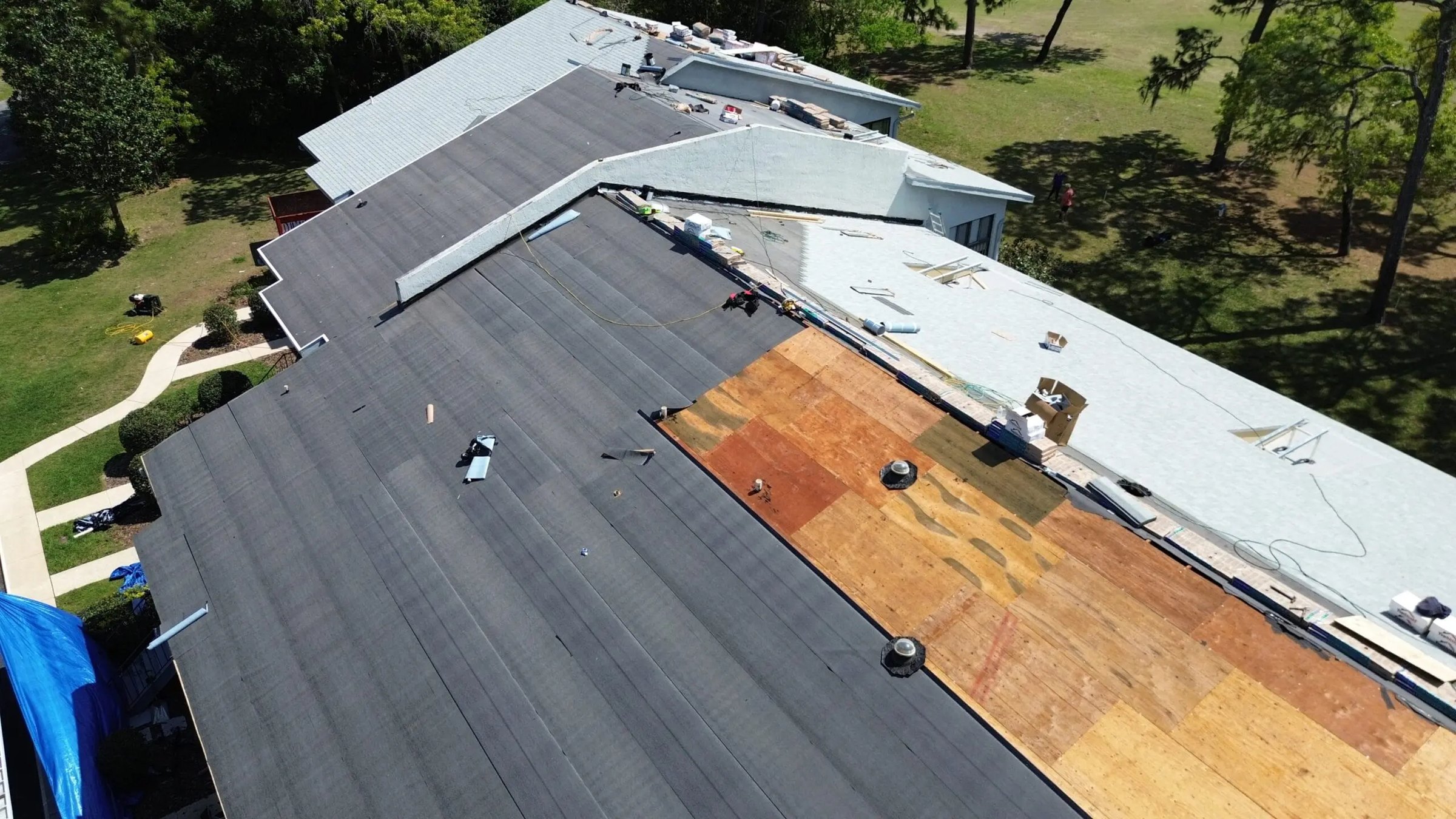
Monsoon season production protocol runs from July 1 through September 30: daily tear-off sections are sized to what the crew can dry in before a potential afternoon storm, with a conservative daily production ceiling that leaves a margin for weather events. We monitor the Desert Research Institute weather feed and NWS Las Vegas afternoon storm probability products from the morning pre-crew meeting through early afternoon. If afternoon storm probability is elevated, we reduce the day's open-section size before starting. An open section that gets rained on is not a minor inconvenience in Las Vegas monsoon conditions — a 1.5-inch rainfall in 45 minutes can damage exposed insulation and compromise the deck in ways that are not apparent until the new membrane goes on.
Section-management discipline — tear off only what can be dried in the same day — is the standard we apply year-round in Las Vegas, not just during monsoon season. Las Vegas is not a market where overnight exposure of an open roof section is acceptable practice. The monsoon protocol is a more conservative version of a standard that applies to every production day on every Las Vegas commercial replacement.
Closeout Package — Documentation That Supports the Warranty
The closeout package is the project's permanent record. It is what the manufacturer's warranty inspector evaluates when a claim is filed, what the building's next owner's due diligence team reviews at acquisition, and what the facility manager's successor uses to understand what system is on the roof and what its warranty status is. In Las Vegas, where resort properties and institutional buildings change ownership and management teams regularly, a complete closeout package has more long-term value than in markets with more stable ownership patterns.
Our standard closeout package includes: the manufacturer's warranty document with the registration number that supports online verification; the roof zone diagram to scale with zones labeled, drains and penetrations marked, and all photos keyed to location; the project specification and product data sheets for every material installed; the fastener pattern calculation record; the insulation R-value and SRI documentation for Nevada energy code; the permit and inspection closeout record from the applicable Clark County AHJ; and the first-year maintenance schedule with contact information for our maintenance program.
We submit the warranty registration to the manufacturer at project completion and coordinate the manufacturer's field inspection where the warranty tier requires it. For resort and gaming properties that carry insurance through specialty carriers, we produce the supplemental documentation that specialty insurers require for underwriting updates — the Las Vegas resort insurance market has specific documentation requirements that differ from standard commercial property coverage.
Frequently asked questions
How long does permitting take for a commercial roof replacement in Las Vegas?
City of Las Vegas and Clark County commercial roofing permits typically run 5-10 business days from complete-application submission. City of Henderson is slightly faster at 5-7 business days on standard projects. Resort corridor projects requiring LVMPD coordination or adjacent-property review can extend to 15+ business days. We submit at contract signing and set the production start date based on actual permit issuance — not an assumed timeline.
How do you handle monsoon season during a Las Vegas roof replacement?
Monsoon protocol runs July 1 through September 30. We size daily tear-off sections to what the crew can dry in before an afternoon storm, monitor storm probability from the morning pre-crew meeting through early afternoon, and reduce the day's section size if conditions warrant. No open sections are left overnight during monsoon season. The monsoon protocol adds some schedule contingency but eliminates the water-intrusion risk that an open section creates during an afternoon thunderstorm delivering 1.5 inches in under an hour.
Do you coordinate the manufacturer warranty inspection, or does the owner?
We coordinate the manufacturer warranty inspection — scheduling the manufacturer's field representative, accompanying them on the inspection, and managing any deficiency corrections before the warranty is issued. At closeout, the owner receives the executed warranty document with the registration number, not a promise that the warranty will be registered. For resort properties with specialty insurance carriers, we provide the additional documentation the insurer requires for underwriting updates.
Planning a roof replacement on a Las Vegas commercial building?
Our project managers will walk the roof, produce the replacement scope, and walk you through the full project plan — permits, staging, monsoon-season production sequencing, and closeout documentation — before you commit to a contract.