
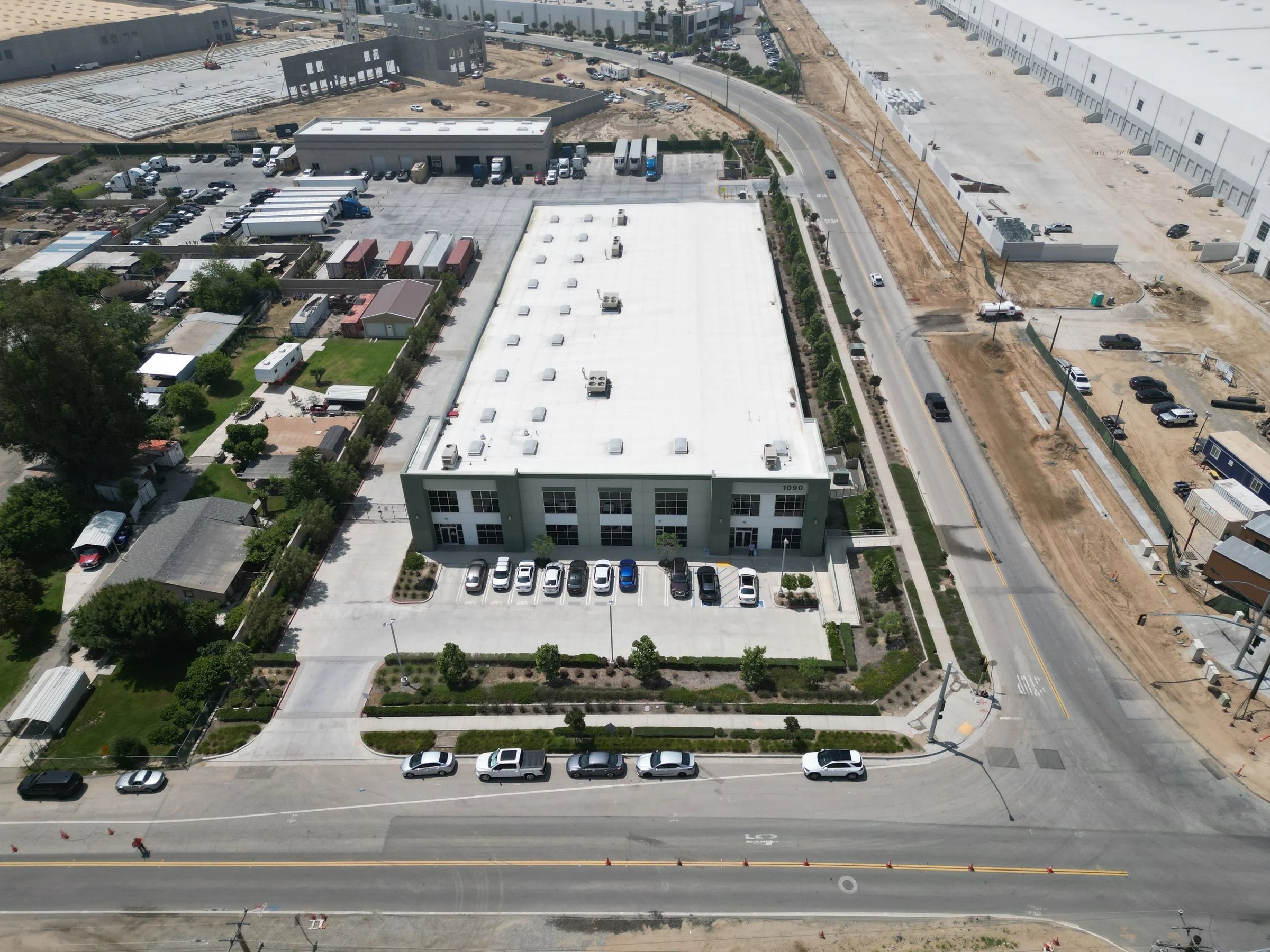
Roof Zone Mapping
Structured roof documentation that helps owners compare repair, restoration, replacement, and budget paths.
How Zone Diagrams Are Built
We start with the building's roof plan if one exists — from the original permit set, from as-built drawings, or from the facility team's records. Clark County permit records are available for buildings permitted through the County, and the City of Las Vegas and City of Henderson maintain permit records for their jurisdictions. If no plan is available, we measure the roof geometry on-site. The diagram is drawn to scale with roof section areas labeled in square feet per zone, drain locations marked, rooftop equipment positions marked, and roof access points marked.
Zone numbering follows a consistent convention: zones run north-to-south and west-to-east, numbered sequentially from the northwest-most section. Sub-zones within a main zone are designated with a letter suffix — zone 4A (field membrane), 4B (parapet return), 4C (drain detail) — so we have both a zone-level reference for field conditions and a sub-zone reference for specific details that need individual tracking. For Strip corridor resort properties with complex multi-level roof configurations — pool decks, convention center spans, tower podium levels, and mechanical penthouse enclosures at different elevations — each level gets a separate zone diagram with a building-level prefix to prevent zone-number collisions across the complex footprint.
For CCSD school buildings, where roof configuration is typically a series of smaller-area roof sections over classroom wings rather than a single large-format commercial plane, we zone each wing separately and prefix the wing designation so the facilities director can navigate from a building plan to the correct zone diagram without ambiguity.
Photo-Keyed Documentation
Every photo in every inspection report is labeled with the zone number and a brief defect descriptor. Photos are organized in the report by zone number so a reader can navigate geographically — find zone 7 on the diagram, turn to the zone 7 section of the photo log, see every photo from that zone in sequence. For Las Vegas facilities teams reviewing inspection reports covering resort buildings with dozens of distinct rooftop conditions, the zone-keyed organization is the difference between a usable document and an unnavigable photo archive.
We photograph every zone on every inspection, including zones in good condition. The absence of defect is documentation — if zone 7 shows a pristine seam and no flashing issues across three consecutive inspections, that record is useful when zone 7 eventually shows UV-driven seam degradation, because the trend data shows when the deterioration began. It is also useful in a warranty claim, where the manufacturer's field inspector can see that the area in question was in good condition as recently as the prior inspection.
For Las Vegas buildings where we are taking over from a prior contractor, we establish the zone diagram on our first inspection and note which zones were photographed versus which zones had prior documentation under a different reference system. We do not backfill prior contractor records — we document the transition clearly so no one mistakes prior unlabeled inspection records for our zone-keyed documentation.
Permanence Across Las Vegas Ownership Transitions
Las Vegas commercial properties — particularly resort and gaming assets — change hands more frequently than most US commercial markets. A gaming license transfer, a REIT portfolio rebalancing, or a private equity exit is a routine event in Clark County's commercial real estate cycle. Each transition is an opportunity for the building's documentation history to disappear — contractor files stay with the contractor, not with the deed.
We maintain the zone diagram and the full inspection record for every building in our program regardless of ownership transitions. When a Las Vegas commercial property sells or transfers gaming license, we can provide the full condition record to the new owner's facilities team or due-diligence counsel upon request. The zone diagram does not change with ownership — the same numbering system applies to the new owner's first inspection that applied to the prior owner's last one. Manufacturer warranty transfers — which require a warranty inspection documenting current condition against the prior maintenance record — are straightforward when the prior maintenance record is in our zone-keyed format, because the manufacturer's field inspector can navigate the inspection history without a contractor present to interpret it.
For CCSD buildings, where facilities director and district superintendent turnover is a normal event, the zone diagram and the inspection record are the institutional memory that does not walk out when a director changes. A new CCSD facilities director inheriting a portfolio of buildings can access the full condition record for each building and understand where each roof sits in its lifecycle without starting from scratch.
Frequently asked questions
Do you produce zone diagrams for Las Vegas buildings you did not install?
Yes. The zone diagram is a documentation tool, not tied to who installed the roof. When we take over an inspection program for a building where we were not the installer — a common situation in Las Vegas where building owners frequently change roofing contractors — our first service is producing the zone diagram and conducting the baseline inspection. The diagram is keyed to the actual current roof configuration, which may differ from any prior as-built drawings if the building has had penetrations added, equipment repositioned, or partial reroofing work since original construction.
What happens to the zone diagram when a Las Vegas commercial roof is replaced?
The zone diagram is updated at replacement closeout to reflect any changes to the roof's physical configuration — new drain locations, equipment repositioning, added or removed penetrations, parapet geometry changes. For Strip corridor resort properties, any changes to communication infrastructure positions are also noted in the closeout update. The prior diagram and the full inspection history under it are archived with the replacement closeout package as the pre-replacement condition record. The updated diagram then starts the new inspection cycle on the replaced roof.
How does the zone diagram format work for a Las Vegas property acquisition due-diligence team?
An acquisition due-diligence team can navigate a zone-keyed condition report without roofing expertise or a contractor present. They can see that zone 9 has a scope column rating of 'budget for replacement,' find the zone 9 photos showing the UV-degraded seam welds and brittle flashing that drove the rating, and find zone 9 on the diagram without needing interpretation. A narrative report with unlabeled photos does not support this. For Las Vegas commercial acquisitions where the roof capital liability may be a material factor in the transaction price, the zone diagram format is the document structure that lets the buyer's team do the work.
Can zone diagrams be integrated with CCSD or resort CMMS systems?
The zone diagram and zone-keyed inspection record are exportable as PDFs with consistent zone nomenclature. We have exported zone records into client CMMS systems where the zone number becomes the asset ID for the roof section. This depends on the CMMS platform and the facilities team's IT support for the import — we provide the documentation in the format the system requires, but we do not administer third-party CMMS platforms. Contact us at 702-820-5349 to discuss what format your system needs.
Get a zone diagram and inspection baseline for your Las Vegas building.
We produce the zone diagram on the first visit and start the inspection record that makes every subsequent report, repair invoice, and capital document usable and comparable — through ownership transitions, monsoon seasons, and contractor changes. Call 702-820-5349 or use the form.