Freeze Damage Roof Repair
Documentation and repair planning for freeze damage roof repair on commercial roofs in the Las Vegas valley.
How Las Vegas Freeze Events Damage Commercial Membranes
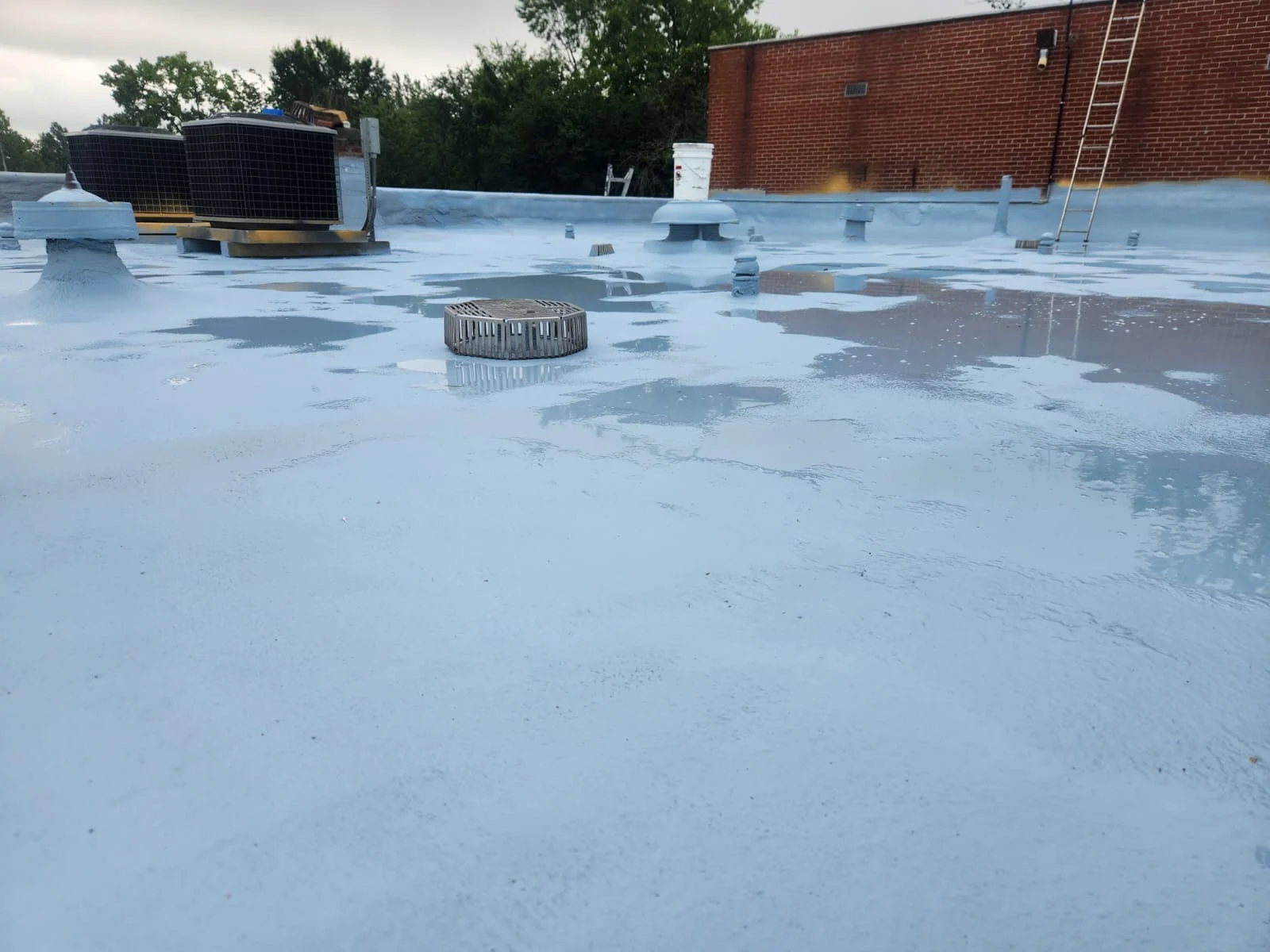
The primary freeze-damage mechanism on Las Vegas commercial roofs is ice formation at drain collar connections and seam edges where residual moisture from monsoon-season ponding is present. When ponded water freezes in a low-spot, the expanding ice mass applies upward pressure to the membrane at the ponding perimeter — a stress direction that membrane systems are not designed for. The membrane can separate from the insulation layer at the ponding boundary, producing a zone of delamination that becomes an intrusion point when the ice melts.
Drain collar connections are the most vulnerable detail in a Las Vegas freeze event. The metal drain body and the membrane collar transition expand and contract at different rates during the rapid temperature cycling that accompanies a Las Vegas cold snap — nighttime lows in the low 20s°F cycling to afternoon highs above 50°F over the same 24-hour period. That thermal differential, combined with ice formation in the drain body if the drain was not flowing freely, can separate the collar-to-membrane connection at the weld or adhesive joint. A separated drain collar is an active intrusion point and a slip hazard on the roof surface.
Modified bitumen and BUR systems on older Las Vegas commercial buildings are more vulnerable to freeze-event membrane cracking than current single-ply systems. Modified bitumen that has experienced multiple seasons of Las Vegas UV exposure and thermal cycling has reduced flexibility at low temperatures — the SBS or APP modifier that provides cold-temperature flexibility degrades over time in extreme UV environments. A 15-year-old modified bitumen roof in Las Vegas may have less cold-temperature flexibility than the same roof age in a lower-UV climate, making membrane cracking during a 22°F freeze event more likely.
Pre-Winter Inspection for Las Vegas Commercial Roofs
The best mitigation for Las Vegas freeze damage is a pre-winter inspection in October or November that addresses three specific conditions: unresolved ponding areas from monsoon season, blocked or partially flowing drains that retain water in the drain body, and moisture-saturated insulation zones beneath the membrane that carry winter freeze risk. These are all monsoon-season legacy conditions that should be remediated before December.
Drain clearing in the pre-winter inspection window removes the desert sand and debris that accumulated over spring and summer and washed into drain bodies during monsoon events. A clean, free-flowing drain that can evacuate water rapidly prevents the drain-body ice formation that leads to collar joint separation. We include drain flow testing — confirming actual flow rate, not just visual confirmation that the drain is open — in every pre-winter inspection.
Ponding remediation in the pre-winter inspection scope addresses low-spots where slope correction or tapered insulation insert installation can prevent water accumulation. Where slope correction is not immediately feasible, we flag the ponding zones, document their location, and recommend emergency drain clearing be scheduled as a priority before any below-freezing forecast period.
Post-Freeze Inspection and Repair Scope
Post-freeze inspection on Las Vegas commercial roofs should occur as soon as temperature conditions allow safe roof access — typically within a week of the freeze event. The damage that freeze events produce is not always visible on initial post-freeze inspection: drain collar separations may be partially masked by residual ice, membrane delamination at ponding perimeters may not be apparent until the membrane dries and the delamination zone becomes palpable. We allow the roof to return to ambient temperature and confirm full drying of residual surface moisture before final documentation.
Infrared moisture scanning in the post-freeze inspection window in Las Vegas is productive: residual moisture in insulation from freeze-affected zones produces a measurable thermal signal for several weeks after the freeze event. We use IR scanning post-freeze to map insulation damage extent beyond what visible membrane inspection reveals, and we confirm IR findings with core samples at representative locations.
Repair sequencing after a Las Vegas freeze event prioritizes drain collar restorations first — a separated collar that is not repaired is an active intrusion risk in any subsequent precipitation event, including winter frontal systems that occasionally bring rain to the Las Vegas valley in December through February. Membrane delamination repairs and wet insulation replacement follow drain restoration in the sequencing.
Frequently asked questions
Las Vegas rarely freezes — is freeze damage inspection worth doing?
The pre-winter inspection that addresses monsoon-season legacy conditions is valuable every year, regardless of whether a hard freeze occurs. Clearing drains, mapping wet insulation from summer ponding, and confirming drain collar connections after monsoon season thermal cycling all reduce winter risk beyond just freeze events — they also reduce the risk of the next monsoon season compounding existing damage.
We had standing water on the roof in August that dried up — is there still freeze risk?
Possibly. Visual drying of the surface does not confirm that the insulation beneath dried. Polyiso insulation that absorbed water during a monsoon-season ponding event retains moisture in the foam cell structure long after the surface appears dry. An infrared scan or core sample at the prior ponding location confirms whether insulation saturation remains — and whether that saturation represents freeze risk in a cold-snap event.
Our roof leaked after the freeze thawed — is that freeze damage or something else?
Post-freeze leaks typically indicate that the freeze event widened an existing marginal condition — a partially delaminated seam, a stressed drain collar connection — into an active intrusion point. The freeze did not create the weakness; it revealed it. The repair scope addresses the specific intrusion points, and the pre-winter inspection scope identifies the conditions that allowed those points to develop.
Freeze damage or post-freeze leak at a Las Vegas commercial building?
We inspect drain collar connections, map insulation saturation from freeze-affected zones, and produce a repair scope that addresses the specific intrusion points the freeze event revealed.