Water Damage Roof Repair
Documentation and repair planning for water damage roof repair on commercial roofs in the Las Vegas valley.
Drain Capacity and Slope Failures in Las Vegas
Commercial flat roof drain design in Las Vegas follows IBC and ASMPE requirements, but those requirements are minimum thresholds. A roof drained to code minimums for Las Vegas's design rainfall intensity may perform adequately in 80 percent of monsoon events and pond significantly in the 20 percent that exceed the design threshold. When we assess a Las Vegas commercial roof after a water damage event, drain capacity and effective slope are the first two items we evaluate — because these are the systemic factors that determine whether water damage is a one-time event or a recurring condition.
Sand and dust accumulation in Las Vegas drain bodies is the most common capacity-reducing factor on Clark County commercial rooftops. The city's desert location means that fine particulate from construction activity, desert floor windblown sand, and particulate from the I-15 and I-215 corridors settles on rooftop surfaces throughout the dry season. Primary drains accumulate sand pack in the drain body below the drain grate — pack that is not visible without removing the grate and inspecting the drain body. We inspect and flush every drain on every post-water-damage inspection, and we document the debris load removed.
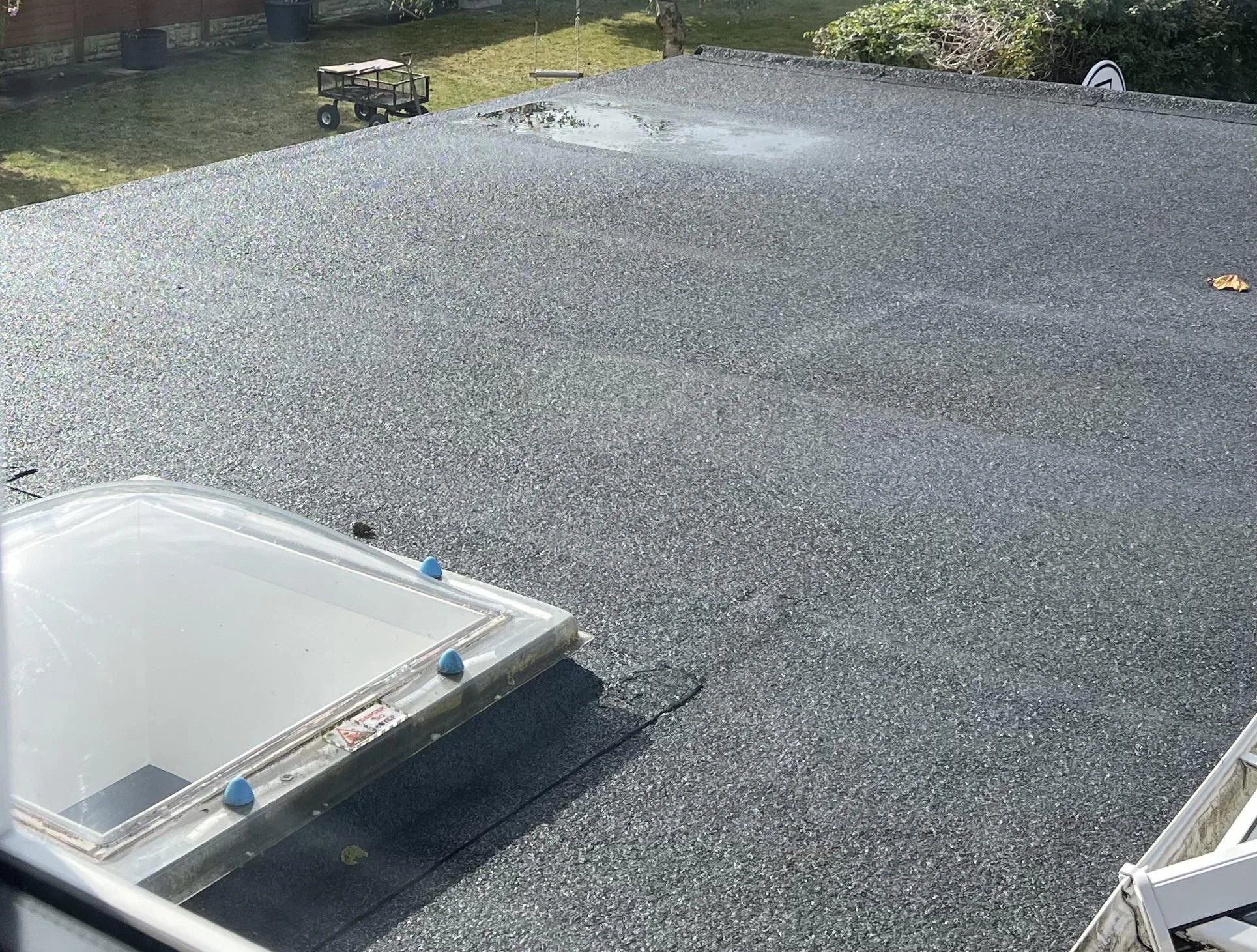
Effective slope failure — areas of the roof where the original tapered insulation specification has compressed or settled under HVAC equipment loading, creating low spots that collect water rather than drain it — is a secondary capacity issue that sand-and-dust accumulation compounds. We scan for effective ponding extent using the membrane surface water line visible after a monsoon event or detectable by infrared moisture mapping. Sustained ponding areas beyond a 48-hour drainage window trigger a slope correction evaluation in the repair scope.
Insulation Saturation Mapping After Ponding Events
Insulation saturation beneath the membrane is the long-term consequence of repeated monsoon-season ponding on Las Vegas commercial roofs. Each monsoon season that produces ponding at the same low-spot locations drives water through marginal seams or pin-holes in the membrane into the polyiso insulation below. Polyiso insulation in a Las Vegas climate — already stressed by daily thermal cycling and UV exposure through the exposed-to-light edges — loses R-value progressively as moisture content increases, accelerates deck corrosion beneath the wet zone, and creates a thermal bridge that shows up in energy cost increases before it shows up as an active leak.
We use two saturation mapping methods on Las Vegas commercial roofs, selected based on the roof type and the investigation context. Infrared thermography works on Las Vegas flat roofs during the post-monsoon period: wet insulation retains heat differently from dry insulation as the roof surface cools in the evening, producing a detectable temperature differential that maps the saturation extent. Capacitance meter scanning is used for ground-truth confirmation at locations identified by IR, and for roofs where the IR window (early evening, significant surface cooling) is not practical for access or scheduling reasons. Core samples at confirmed wet locations establish insulation saturation depth and condition.
The saturation map drives the repair scope for wet insulation replacement. On Las Vegas roofs where saturation has been accumulating across multiple monsoon seasons, the wet zone commonly extends significantly beyond the visible interior water damage footprint. We map the full saturation extent before scoping the replacement area, because cutting the replacement boundary at the visible damage zone and leaving wet insulation adjacent is a scope error that produces the same saturation problem in the next monsoon cycle.
Interior Water Damage Documentation for Claims
Interior water damage documentation for a Las Vegas commercial property claim requires establishing the relationship between the roof water entry point and the interior damage location. In single-story commercial buildings — the dominant commercial building type on the I-15 corridor, in Henderson's industrial zone, and in the North Las Vegas Apex area — the relationship is typically direct: the roof entry point is above the interior damage location. In multi-story buildings, the relationship can be indirect: water entering through a roof penetration may travel through the structural system before exiting into an occupied space one or more floors below.
We photograph and document interior water damage as part of every water damage repair assessment: ceiling stain extent with measurements, wall penetration at any point where water entered interior wall cavities, floor surface water damage extent, and any evidence of mold or moisture damage to stored inventory or building contents in the affected zone. This interior documentation is produced alongside the roof entry-point documentation — the two together establish the water pathway that the claim scope needs to address.
For Las Vegas commercial buildings on Strip-adjacent or resort-adjacent insurance programs — properties that carry specialty commercial property coverage through carriers that include USAA, Farmers, State Farm, Liberty Mutual, or Nevada-specific underwriters such as Saguaro Casualty — the documentation standards for water damage claims may differ from standard commercial property adjusting. We produce documentation at whatever detail level the carrier's adjusting requirements specify.
Frequently asked questions
The ponding dried up after the storm — do we still have water damage?
Very likely yes. Ponding water that sits on a Las Vegas commercial roof for 12 to 48 hours after a monsoon event has typically driven moisture into marginal seams and penetration flashings even after the surface water evaporates. The insulation saturation that results does not evaporate — it stays in the insulation layer and accumulates across multiple monsoon seasons. An infrared scan in the post-monsoon window identifies saturation extent that surface appearance does not reveal.
How do we know if the water damage is covered under our Nevada commercial property policy?
That determination is between you, your carrier, and your adjuster. We produce the documentation that shows what happened to the roof — water entry points, saturation extent, interior damage correlation — and we can produce it in whatever format the carrier requires. We do not advise on policy coverage questions.
Can you do emergency dry-in the same day we call?
Yes, for buildings in the core Las Vegas market — downtown, the Strip corridor, Spring Valley, and Henderson. From our South Las Vegas Boulevard office at 6671 S Las Vegas Blvd, Suite 210, most Clark County commercial buildings are reachable within 30 to 45 minutes for emergency mobilization. North Las Vegas and the Apex industrial corridor are typically within one hour. Emergency tarping and temporary dry-in are available for buildings off our maintenance contract on a capacity basis during major monsoon events.
Water damage to a Las Vegas commercial roof?
We map water entry points, insulation saturation extent, and interior damage correlation in a format your adjuster can use — and we get emergency dry-in on-site fast.